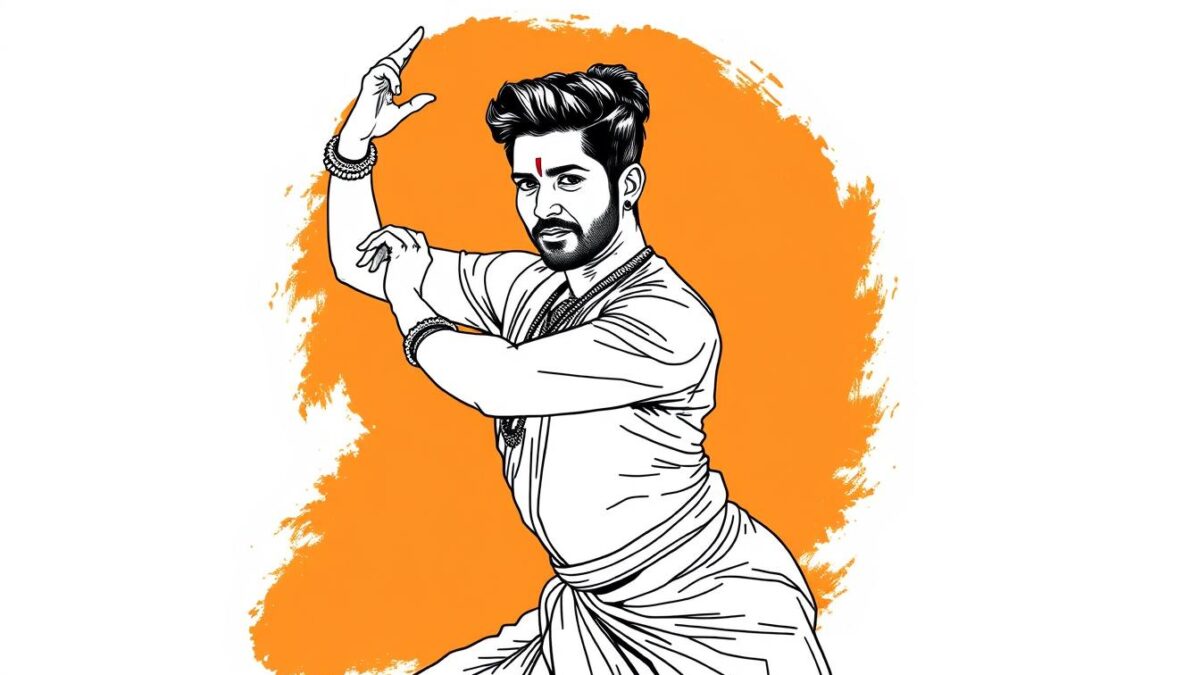
Prabhu Deva began his life in Mysore, India, in 1973. His career now spans over three decades across multiple Indian film languages. This Indian dance choreographer earned two National Film Awards and the Padma Shri for his art.
He grew up in a film family. Dance was his first language, learned from his father. This foundation gave him a unique blend of classical skill and raw energy.
His work as a dance choreographer and dancer made him a household name. Fans often compare his electric style to Michael Jackson. He moves with a precision that feels both practiced and spontaneous.
The artist expanded his role to become a producer actor and director. He proved that deep mastery in movement could open other creative doors. His influence on Indian cinema remains strong and direct.
Foundations in Dance and Family Heritage
The rhythm of cinema was the first language spoken in Prabhu Deva’s childhood home in Mysore. His father, Mugur Sundar, worked as a choreographer for South Indian films. This environment made dance a natural part of daily life.
Early Influences and Childhood
Watching his father construct song sequences gave him an insider’s view. He learned how movement serves narrative and connects with an audience. This practical education was as crucial as formal training.
His brothers, Raju Sundaram and Nagendra Prasad, also entered the film industry. They created a family ecosystem built on movement and music. Each sibling supported the others while carving distinct paths.
Cultural and Classical Dance Training
His formal training began with the rigorous classical form of Bharatanatyam. He studied under gurus Dharmaraj and Udupi Lakshminarayanan. This instilled a deep respect for precision, posture, and emotional expression.
His training extended to Western dance styles. This hybrid foundation became his signature. It allowed him to blend tradition with modernity throughout his long career.
The years of disciplined practice taught him that dance is a controlled art. It requires timing and clarity. This early grounding gave him the skill to innovate with intention.
Breakthrough in Cinema and Dance
A fleeting image of a boy with a flute in a classic Tamil song marked the quiet beginning of an icon’s journey. This small role planted a seed in the visual memory of audiences.
From a Boy Playing the Flute to a Dance Icon
In the 1986 Tamil film Mouna Ragam, he appeared as a boy playing a flute in the song “Panivizhum Iravu.” Directed by Mani Ratnam, this moment connected him early to legendary music and storytelling.
He continued working behind the scenes. Roles as a background dancer in films like Agni Natchathiram (1988) taught him how movement works on camera.
His first choreography credit came with the 1989 film Vetri Vizha, starring Kamal Haasan. This shift moved him from performer to creative architect of dance sequences.
His acting debut arrived in Indhu (1994). But his second film, Kaadhalan (1994), directed by S. Shankar, created a national sensation. Songs like “Mukkabla” and “Urvasi Urvasi” fused classical skill with electric energy.
The success of this Tamil film was cultural. His dance moves became anthems, replicated everywhere. This cemented his status as a true dance icon.
| Year | Film | Role | Significance |
|---|---|---|---|
| 1986 | Mouna Ragam | Boy playing flute (cameo) | First on-screen appearance |
| 1988 | Agni Natchathiram | Background Dancer | Learned cinematic choreography |
| 1989 | Vetri Vizha | Choreographer | First credited choreography work |
| 1994 | Kaadhalan | Lead Actor | National breakthrough and icon status |
Prabhu Deva and His Impact on Indian Dance
Minsara Kanavu’s iconic songs showcased a new language of movement that would redefine Indian cinema. The artist transformed dance sequences from background decoration to essential storytelling tools.
Signature Choreography and Dance Styles
His choreography blends Bharatanatyam precision with hip-hop fluidity. This fusion created a signature style that feels both traditional and modern.
The National Film Award for Best Choreography recognized his work on “Strawberry Kannae” and “Vennilave.” These songs demonstrated his surgical precision in matching movement to emotion.
Another National Film Award came for the Hindi film Lakshya. This proved his skills translated across language barriers and regional industries.
Innovation in Dance Sequences on Screen
Prabhu Deva redefined how dance functions in film. His sequences became character revelations rather than simple entertainment breaks.
In 1999, he performed at the Michael Jackson tribute concert in Munich. This international appearance confirmed his status as India’s leading dance artist.
He established the Prabhu Deva Dance Academy in Singapore in 2010. There, he passes his methods to new generations seeking discipline and creativity.
His critically acclaimed work continues to set benchmarks. Each sequence is studied for its construction and relationship to camera, music, and story.
Evolution of a Versatile Acting Career
His dance fame opened doors to acting roles that would test his screen presence beyond movement. The performer quickly established himself as a bankable leading man.
Memorable Film Roles and Critical Acclaim
Prabhu Deva featured in several commercially successful films during the 1990s. Projects like Kaadhalan (1994) and Minsara Kanavu (1997) built his reputation. Each film showcased his unique blend of dance, charm, and screen presence.
His performance alongside Kamal Haasan in Kaathala Kaathala (1998) earned critical acclaim. The comedy proved he could hold his own with established actors. This film demonstrated his range beyond dance sequences.
Later works including Vanathai Pola (2000) continued to connect with audiences. However, the mid-2000s brought challenges to his acting career. Many projects failed to match earlier box office success.
The performer eventually shifted toward supporting roles. This adaptation reflected the natural evolution of his film career over the years. His legacy remains defined by the energy and physicality he brought to every role.
Transition to Film Direction and Production
The camera’s perspective shifted in 2005 when the choreographer stepped behind it to direct his first feature. This move from creating dance sequences to shaping entire narratives represented a natural evolution of his cinematic vision.
Success with Nuvvostanante Nenoddantana and Beyond
Prabhu Deva made his directorial debut with the Telugu film Nuvvostanante Nenoddantana. The project became an immediate blockbuster, proving his instincts extended beyond movement to complete storytelling.
This Telugu film achieved remarkable recognition. It was remade in seven languages, a first for Indian cinema. The film won nine Filmfare Awards, including Best Choreographer for Prabhu Deva.
The success allowed him to recreate success earlier found as a performer. He shifted focus from acting to directing, gaining greater creative control. This transition wasn’t a departure but an expansion of his artistic range.
He followed with highly profitable films across multiple industries. Projects like Pokkiri, Wanted, and Rowdy Rathore demonstrated his commercial understanding. Each film showcased his ability to adapt to different audiences while maintaining his signature style.
Prabhu Deva brought his choreographer’s eye for timing and spectacle into every directorial decision. His understanding of movement informed camera angles, editing rhythms, and performance guidance. This unique perspective solidified his reputation as a director who understood mass appeal.
Current Projects and Emerging Ventures
From silent thrillers to police dramas, Prabhu Deva’s recent filmography demonstrates remarkable genre versatility. His work now spans comedy, action, and intense character studies.
Recent Film Appearances and Directorial Works
After an 11-year gap, Prabhu Deva returned to Tamil cinema with the 2016 trilingual film Devi. This project marked his re-entry into leading roles across multiple languages.
His 2019 film Charlie Chaplin 2 saw him reprise a beloved character while adding lyricist to his credits. The same year, he directed the high-profile action film Dabangg 3.
Recent projects showcase his expanding range. The 2021 film Pon Manickavel featured his first police officer role. Bagheera (2023) revealed his ability to handle darker, complex characters.
| Year | Film | Genre | Notable Achievement |
|---|---|---|---|
| 2018 | Mercury | Silent Thriller | Experimental genre departure |
| 2019 | Charlie Chaplin 2 | Comedy | Debut as lyricist |
| 2021 | Pon Manickavel | Action Drama | First police officer role |
| 2023 | Bagheera | Thriller | Intense character performance |
| 2024 | Karataka Damanaka | Period Film | Return to Kannada cinema |
Exploring New Genres and Global Collaborations
Prabhu Deva continues to push creative boundaries. His 2021 directorial project Radhe was a remake of the South Korean film The Outlaws.
This global adaptation demonstrates his interest in cross-cultural storytelling. It follows his successful pattern with Rowdy Rathore earlier in his directing career.
His 2024 projects include The Greatest of All Time with director Venkat Prabhu. These selections show his strategic choices in maintaining relevance across India’s film industries.
Accolades, Awards, and Lasting Recognitions
The trajectory of awards tells its own story about how Indian cinema learned to value choreography as art. Recognition accumulated across decades, marking shifts in how movement was perceived on screen.
National Film Awards and the Padma Shri Honor
Prabhu Deva earned the National Film Award for Best Choreography twice. The first came for his work in Minsara Kanavu in 1997. A second National Film Award followed for Lakshya in 2004.
These national film awards validated choreography as essential cinema artistry. They marked his sequences as integral to each film’s success.
Over the years, Prabhu Deva featured in numerous award ceremonies. He collected Filmfare Awards and regional honors across industries. His Nandi Awards for Telugu films like Rakshana demonstrated remarkable versatility.
The Kalaimamani Award in 2015 honored his Tamil film contributions. But the pinnacle arrived in 2019 with the Padma Shri. This civilian honor acknowledged his impact on Indian culture through dance.
These film awards represent more than personal achievement. They mark a broader recognition of choreography’s power in storytelling.
Reflections on a Timeless Legacy and Future Horizons
Three decades of movement have cemented Prabhu Deva’s legacy as Indian cinema’s most influential kinetic artist. His career spanning dance, acting, and direction redefined how physical expression serves story.
This choreographer built his legacy through commercially successful films across Tamil and Telugu industries. From early breakthroughs to recent projects like Pon Manickavel, his work consistently pushes creative boundaries.
Beyond the screen, Prabhu Deva maintains roots in Mysore through property ownership and farm development. His production company now shapes projects from conception, ensuring his artistic vision continues evolving.
The future holds new genres and collaborations for this enduring artist. Each film adds another layer to a legacy that continues inspiring new generations of performers.