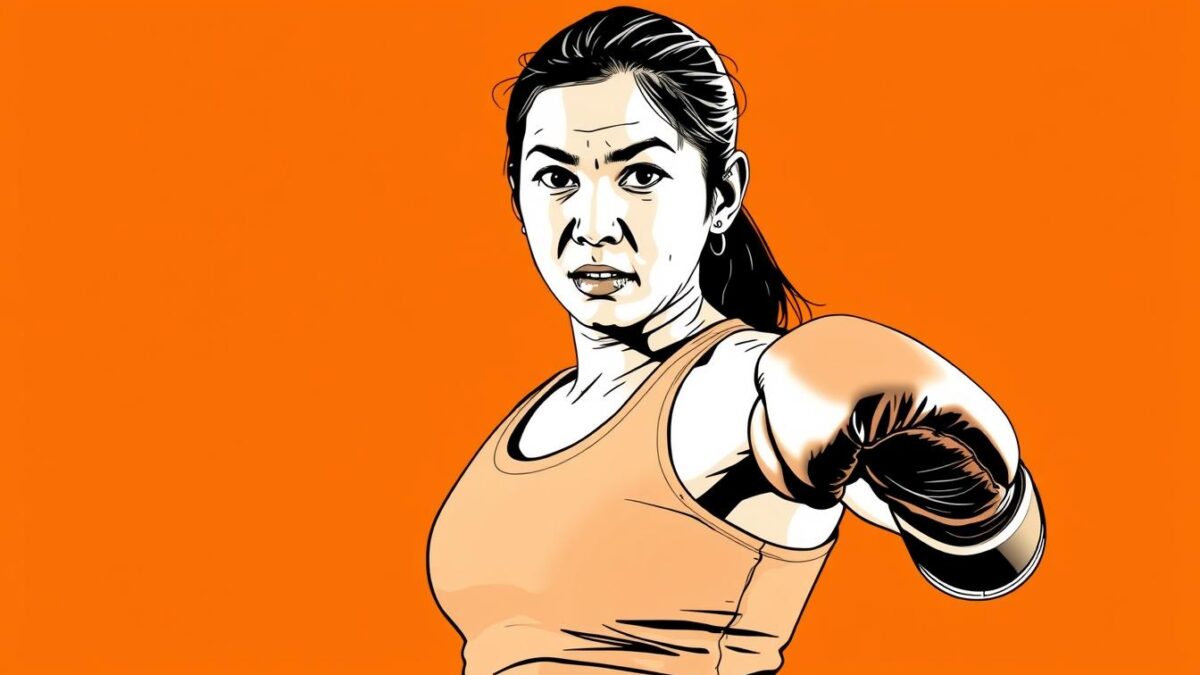
Few athletes command a legacy like the champion from Manipur. Her record stands alone in the history of amateur boxing.
She owns six world championship titles. No other boxer, male or female, has ever won eight medals at that level. This dominance earned her the nickname “Magnificent Mary.”
Her journey broke new ground for women in sports. At the 2012 London Olympics, she became the first Indian female boxer to win a medal, taking bronze.
This achievement arrived after a path from a small village. It shows what fierce determination can build.
Her impact stretches far beyond the ring. The Indian government recognized her contributions with the Padma Vibhushan, Padma Bhushan, and Padma Shri awards.
Her story is one of balancing motherhood with championship training. She continued to compete at the highest level well into her career.
This is a look at how she reshaped a sport. It’s about the sacrifices and the spirit that made her an icon.
Early Life and Inspirational Beginnings
Kagathei village, nestled in Manipur’s Churachandpur district, was where an extraordinary story took root. The Kom family lived as tenant farmers, working jhum fields that demanded daily physical labor.
Humble Origins in Manipur
Her parents, Mangte Tonpa Kom and Mangte Akham Kom, cultivated the land while raising three children. The family understood scarcity, but her father’s wrestling background planted athletic seeds. Farm chores built the physical toughness that would define her future career.
Hard work filled those early years of life. Balancing school with field labor created relentless discipline. This routine shaped her drive to create a different future.
Early Influences and Athletic Aspirations
At Loktak Christian Model High School, Mary Kom showed athletic promise in javelin and 400-meter running. But everything changed when fellow Manipuri boxer Dingko Singh won gold at the 1998 Asian Games.
His victory proved someone from their state could compete globally. It sparked something in the young athlete. She began secret training at age fifteen, hiding boxing from her father who worried about her face and marriage prospects.
When newspapers published her photo after winning the state championship in 2000, the secret was out. Her father eventually recognized her talent, becoming one of her strongest supporters after initial tension.
Boxing Career Breakthroughs and Training Journey
A calculated gamble in 2000 would redefine Indian women’s sports as an athletic prodigy entered the boxing ring. This shift from track and field required immense courage. The sport offered no clear path for female athletes in India at that time.
Transition from Athletics to Boxing
Mary Kom abandoned her promising javelin and running career for boxing. Her first coach, K. Kosana Meitei, immediately recognized her mental toughness. She possessed the rare willingness to absorb punishment while pressing forward.
At fifteen, she left her village for the Imphal Sports Academy. Limited resources and rigorous training defined those early years. The young boxer learned footwork and ring strategy from dedicated coaches.
Transformative Training Experiences
Her training regimen combined traditional boxing techniques with intense conditioning. Farm labor had built a strong physical foundation. This background served her well in the demanding world of amateur boxing.
The breakthrough came at the 2001 World Championships in Scranton. At eighteen, she won silver and announced India’s presence on the global stage. This early success validated her risky career change.
| Weight Class | Competition Years | Key Achievement |
|---|---|---|
| 46kg (Pinweight) | 2001-2005 | First World Championship medal |
| 48kg (Light Flyweight) | 2006-2010 | Olympic qualification category |
| 51kg (Flyweight) | 2012-present | Olympic bronze medal |
Throughout her career, Mary Kom also navigated changing weight categories. International rule modifications forced constant adaptation. She adjusted her body and fighting style multiple times to remain competitive.
Mary Kom: Trailblazer in Boxing
Six gold medals across sixteen years define a dominance that reshaped women’s boxing globally. Her championship performances set new standards for consistency and excellence in the sport.
Historic World Championship Performances
The champion’s world boxing career began with a breakthrough in 2002. She became the first Indian boxer to win gold at the world championships in Antalya, Turkey.
This victory started an unmatched record of success. Over the next sixteen years, she collected six gold medals at boxing championships. Her consistency across different weight classes demonstrated remarkable adaptability.
| Year | Location | Weight Class | Result |
|---|---|---|---|
| 2002 | Antalya, Turkey | 45kg | Gold Medal |
| 2005 | Podolsk, Russia | 46kg | Gold Medal |
| 2006 | New Delhi, India | 46kg | Gold Medal |
| 2008 | Ningbo, China | 46kg | Gold Medal |
| 2010 | Bridgetown, Barbados | 48kg | Gold Medal |
Memorable Olympic Moments
London 2012 marked women’s boxing’s Olympic debut. The boxer seized this historic opportunity, becoming India’s first female Olympic medalist in the sport.
Her journey included victories over Poland’s Karolina Michalczuk and Tunisia’s Maroua Rahali. Though she lost in the semifinals to Great Britain’s Nicola Adams, the bronze medal secured her place in Olympic history.
This achievement validated years of training and sacrifice. It represented a milestone for women boxing globally.
Achievements and Recognitions in the Ring
Beyond the world championship dominance lies a comprehensive collection of international honors. The athlete’s trophy case spans multiple continents and competition levels.
International Medals and Titles
Her Asian Games gold in 2014 marked a historic first for Indian women’s boxing. She defeated Kazakhstan’s Zhaina Shekerbekova to claim the flyweight title.
The 2018 Commonwealth Games brought another breakthrough gold medal. This victory came when her weight category finally joined the competition program.
| Competition | Year | Medal | Significance |
|---|---|---|---|
| Asian Games | 2014 | Gold | First Indian female boxing gold |
| Commonwealth Games | 2018 | Gold | First Indian woman to win |
| Asian Championships | 2003-2017 | 5 Gold | Record six Asian medals total |
| Asian Games | 2010 | Bronze | Flyweight category achievement |
National Awards and Prestigious Honors
India’s civilian honors chart her growing impact through the years. The Padma Shri in 2006 recognized emerging talent.
The Khel Ratna award in 2009 placed her among India’s sporting elite. This highest sporting honor acknowledged her consistent excellence.
Later came the Padma Bhushan after Olympic success. The Padma Vibhushan in 2020 capped this remarkable progression of awards.
Impact on Sports, Culture, and Media
Cultural representation and systemic advocacy became the next frontier after competitive dominance. Her story transcended the sport to influence broader conversations about women’s potential.
Role in Empowering Women in Boxing
The champion fundamentally changed women boxing in India. She proved that Indian female athletes could dominate a combat sport traditionally reserved for men.
Her success opened doors for subsequent generations. Government sports programs and boxing academies began prioritizing women’s participation.
Institutional roles amplified this impact. As national observer for boxing and IOC athlete ambassador, she gained power to shape policies and advocate for resources.
The sports club she runs in Manipur offers free training to young boxers. This ensures opportunities for children from poor families, extending her impact beyond her own ring career.
Representation in Films and Documentaries
Her 2013 autobiography “Unbreakable” gave readers direct access to her voice. It detailed daily struggles alongside victories, showing the reality behind the glory.
The 2014 biographical film starring Priyanka Chopra brought her journey to mainstream audiences. It inspired young women across India to challenge traditional gender expectations.
Documentary “With This Ring” captured six years of India’s women’s boxing team. It showed unglamorous training and determination required for Olympic representation.
Inclusion in “Good Night Stories for Rebel Girls” placed her alongside global icons. Her story became essential reading for children learning about women who defied limitations.
Overcoming Personal Challenges and Societal Barriers
The greatest fights often happened outside the ring, where societal expectations clashed with athletic ambition. Traditional attitudes viewed boxing as unsuitable for women, particularly in her home state.
Balancing Family Life and a Sporting Career
Marriage in 2005 and twin sons in 2007 created the exact scenario critics had warned about. Many assumed her career would end with family responsibilities.
The champion proved otherwise. After a brief hiatus, she returned to training with renewed determination. Winning world championship gold just months after childbirth silenced doubters.
Juggling training schedules with raising three sons required meticulous planning. Early morning runs happened before children woke. Training sessions fit between school pickups.
Weight category changes added another layer of complexity. Adjusting body composition while managing family life demonstrated incredible adaptability. Her career showed that motherhood and athletic excellence could coexist.
Through divorce in 2023 and other personal challenges, she maintained focus on boxing and mentoring young athletes. The journey continues from her current home in Haryana state.
Final Reflections on a Boxing Legend
The statistics alone place this boxer in a category that transcends typical sporting success. Six world championship gold medals and eight total world medals represent a record that may never be broken in boxing history.
Her twenty-one year career bridged eras for women in sports. From early world championships to Olympic glory, she helped transform women’s boxing into a mainstream pursuit.
The financial breakthrough came in 2015 when she became India’s first amateur athlete to surpass professional earnings. This proved Olympic sports could offer viable careers.
Beyond the ring, her advocacy for animal rights and free training for young boxers extends her impact. The road named in her honor symbolizes paths created for future generations.
Mary Kom’s ultimate legacy lives in the young women who now see boxing as possibility. Her journey from rural beginnings to global podiums redefined what women can achieve in sports.