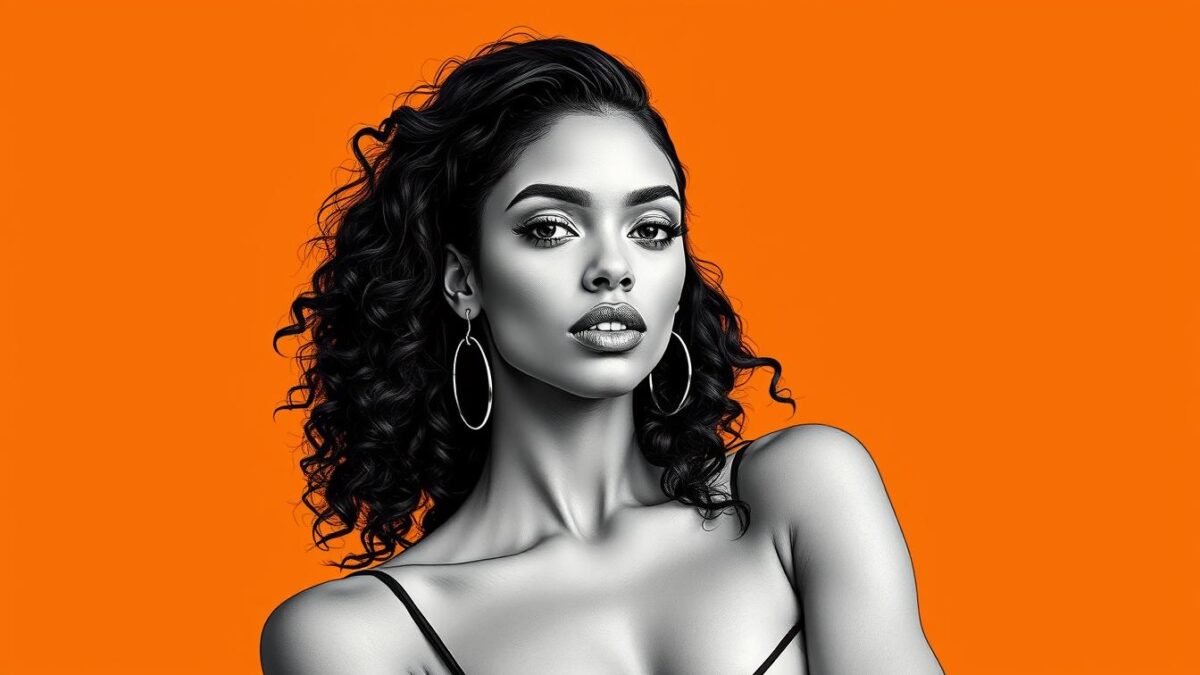
Her presence on a global runway commands attention. Imaan Hammam has become one of fashion’s most compelling voices. Her work extends far beyond beauty campaigns.
This conversation moves past surface-level coverage. It digs into questions of identity, faith, and ambition. We explore what cultural representation truly means today.
Born in Amsterdam to an Egyptian father and Moroccan mother, her path started young. Scouted as a teenager, she is now a fixture on international runways. Her face has graced numerous Vogue covers.
Her career reflects deliberate choices, not a fairy tale. She navigates the tension between her Muslim identity and the fashion industry’s norms. This awareness shapes her every move.
A recent milestone solidified her influence. She became the first Afro-Arab ambassador for Estée Lauder. She calls it a validating moment that opens doors for others.
We talk about her roots, her rise, and her plans. Her project Ayni, a cultural archive for Arab art, signals a future beyond modeling. Her platform continues to grow with purpose.
Early Beginnings and Cultural Roots
Amsterdam’s multicultural landscape provided the backdrop for a childhood shaped by two distinct North African traditions. Imaan Hammam’s story begins with this rich cultural foundation.
A Window into Her Diverse Heritage
Her Egyptian father from Cairo and Moroccan mother from Zagora met in the Netherlands as immigrants. Her mother arrived at nineteen, working as a seamstress while teaching Dutch to newcomers.
Her father brought his musical background to their new life. At home, Arabic remained the primary language, preserving their heritage in a Western European city.
Formative Years in Amsterdam
Economic challenges marked this time in her life. The family sometimes went weeks without proper meals, creating a stark contrast to her future success.
When her parents divorced, she stayed with her mother and younger sister alongside four half-siblings. This blended family required resilience and adaptation.
Her father introduced her to classic Egyptian cinema, films by Youssef Chahine filled with elegance and drama. These early experiences with Arab storytelling would later influence Hammam’s own cultural projects.
These formative years instilled a dual consciousness that would serve her well in the fashion world. She learned to navigate between Dutch society and her Arab roots from an early age.
Breaking Into the Fashion Industry
The fashion world found its next star not in a casting call, but amid the daily commute of Amsterdam’s central hub. This unexpected beginning set the pace for a career that would quickly accelerate beyond typical expectations.
Discovery at Amsterdam Central Station
In 2010, a CODE Management agent spotted thirteen-year-old Imaan Hammam in the crowd. They recognized something the industry desperately needed. The encounter led to her first contract at sixteen.
Her debut came swiftly on the Jean Paul Gaultier Couture runway in 2013. That same year brought an exclusive honor from Riccardo Tisci. She opened the Givenchy show, signaling her unique potential.
| Year | Milestone | Significance |
|---|---|---|
| 2010 | Discovered at Central Station | Entry into modeling world |
| 2013 | Jean Paul Gaultier debut | First major runway appearance |
| 2013 | Givenchy exclusive opening | Industry recognition |
Balancing school with modeling proved challenging. Hammam attended classes when home and joined via Skype while traveling. The demands of castings and fittings eventually made academics secondary.
Industry insiders encouraged her move to New York. This decision accelerated her career but meant leaving behind a traditional adolescence. She signed with agencies across major fashion capitals simultaneously.
She admired models who combined beauty with purpose. Figures like Raquel Zimmermann and Liya Kebede showed how platforms could extend beyond clothing. Her entry coincided with growing diversity conversations in fashion.
Defining Moments on the Runways and Covers
A US Vogue cover at eighteen announced a new force in fashion. This milestone for Imaan Hammam felt surreal. Anna Wintour’s rare editorial mention signaled deep industry support.
Her presence on magazine covers quickly became a constant. By 2017, she appeared on British, Japanese, and multiple US Vogue editions. Sharing a cover with Pharrell Williams cemented her status beyond typical modeling circles.
Debut Highlights and Major Campaigns
Winning Couturesque Magazine’s Model of the Year in 2016 proved her public appeal. She secured over half the vote against major names. This victory showed her connection with audiences who follow fashion.
Her appointment as the face of Chanel beauty broke new ground. Imaan Hammam became the first Black-Arab model to hold the title. This was a personal and political validation for many aspiring models.
The Versace F/W 2018 show highlighted her commanding runway walk. Her confident presence became a talking point. It reminded the industry that a powerful walk still defines a great show.
Working with Top Fashion Houses
Appearing on Vogue Arabia with her idol Iman felt like a full-circle moment. It represented two generations of Black models redefining beauty standards. This cover was a significant personal achievement.
Achieving the “Big Four” Vogue covers in 2021 placed her among fashion’s icons. This rare benchmark separates working models from legends. It is a key goal for top models in the industry.
Her 2023 role as an Estée Lauder ambassador was a career capstone. It positions her as a beauty authority, validating years of dedicated work. This move signals a lasting influence in the beauty and fashion world.
Reflecting on Faith, Identity, and Representation
The relentless pace of the fashion industry rarely makes space for personal devotion. Imaan Hammam carves it out deliberately. Her Muslim faith requires active choices, not passive observance.
In 2023, she took the entire month of Ramadan off. She told her agents it was a time for healing and no work. This decision set a firm boundary in a field that seldom pauses.
Past experiences informed this choice. She has fainted on set during the holy month. The physical demands of shoots while fasting proved too much.
Balancing Faith with a Modeling Career
Her mother’s guidance remains a constant. She advised doing the work in a way that respects both herself and their religion. This mandate forces careful evaluation of every job and outfit.
The tension is real. Wearing a revealing look to an event can bring disapproval from home. She feels caught between industry expectations and personal values.
She finds grounding at the Islamic Center at NYU. Attending Friday prayers with Imam Khalid Latif offers a community that sees beyond the model. It is a space where her identity is centered.
She proudly identifies as Afro-Arab, correcting those who label her Middle Eastern. This clarity about her heritage is non-negotiable. It is a core part of how she represents herself to the people who follow her.
Social media is a complex tool for Imaan Hammam. She receives hateful messages questioning her choices. But she also uses the media to share her identity, helping many feel seen. Her visibility promotes a vital form of diversity for young girls.
Imaan Hammam: Trailblazing Influence in the Fashion Industry
The modeling industry’s landscape was starkly different when she first arrived. Her rise coincided with intense scrutiny of the fashion world’s historic exclusion. She acknowledges progress but remains clear-eyed.
“We can always do better,” she states. Yet she sees change. “Now, if you look at most magazine covers, you see a lot of diversity. That makes me really happy.”
Shattering Stereotypes and Celebrating Diversity
Early castings felt like battlegrounds. Designers rarely booked more than one Black model per show. This pitted models against each other, creating isolation.
Legendary activist Bethann Hardison became a crucial mentor. She fostered camaraderie among emerging Black models. She organized dinners and group chats to build solidarity the industry lacked.
Hardison saw a unique quality in Imaan Hammam. “She has this kind of beauty that you don’t get tired of,” Hardison noted. She praised her work ethic and presence, highlighting a generosity that lifts others up.
Growing up without seeing herself represented made it hard to feel beautiful. Now, she uses her visibility to give younger girls that crucial representation. Her platform openly discusses her Moroccan-Egyptian and Muslim identity, helping many feel seen.
Impact on Global Fashion Culture
Her influence extends beyond the runway. It marks a cultural shift towards greater inclusion. She is proud to be part of the generation pushing for this change.
The industry’s evolution is tangible. The following table contrasts the environment then and now.
| Aspect | Industry Past | Industry Present |
|---|---|---|
| Representation on Covers | Limited diversity, tokenism | Increased variety, more authentic inclusion |
| Casting Dynamics | Competitive among models of color | Growing solidarity and mentorship |
| Beauty Standards | Narrow, Eurocentric focus | Broader, more global definition of beauty |
This progress reflects the work of many. Imaan Hammam’s career is a testament to that ongoing effort. Her impact is measured in both her success and the doors she helps open.
Insights and Aspirations for the Future
A refrigerator door holds more than just magnets; it reveals ambitions that stretch beyond the runway. Imaan Hammam’s 2023 goals list shows a woman building a legacy with purpose.
Her cultural project Ayni archives Arab art, cinema, and music. It began as an Instagram account but aims to become a collaborative hub. Within a year, she hopes it becomes a true discovery platform.
Expanding Her Platform and Legacy
Five years from now, Ayni could host exhibitions and fund creative projects. It would support young Arab artists across the diaspora. This vision extends her influence beyond traditional modeling work.
She balances this with personal growth. Hammam studies Business English and practices Brazilian jiujitsu. She volunteers with the Asiyah Women’s Center, supporting domestic violence survivors.
| Current Initiatives | Future Goals |
|---|---|
| Ayni Instagram archive | Physical exhibitions and workshops |
| She’s the First ambassadorship | Expanded educational partnerships |
| Beauty campaigns and runway work | Cultural curation and production |
| Language learning (Dutch, Arabic, English) | Mastering additional languages |
Recognition like Forbes’ 30 Under 30 and She’s the First’s “Powerhouse of the Year” award validate her approach. Anna Wintour presented the latter honor in 2021.
Her appearance in Doja Cat’s “Gorgeous” video shows comfort in new creative spaces. Each project builds toward a lasting impact that will outlive her modeling career.
Closing Reflections on a Journey of Empowerment
Twenty-two Vogue covers later, Imaan Hammam’s career reflects a journey measured in more than magazine spreads and beauty contracts. After ten years in the fashion world, she has built a life with deliberate intention beyond the industry’s glare.
Her Brooklyn apartment serves as a personal sanctuary, rearranged every six months to satisfy her Libra need for change. She films cooking videos with fellow models, sharing traditional dishes that connect her to cultural roots. These friendships offer solidarity in a competitive business.
Hammam uses social media for advocacy, addressing food insecurity and political issues with the same conviction she brings to her work. Industry rankings place her among icons, but her true impact lies in showing young people they belong.
Her legacy extends beyond any single show or campaign season. She proves that success in this demanding career can coexist with purpose, faith, and community. The model continues to redefine what beauty means in our time.