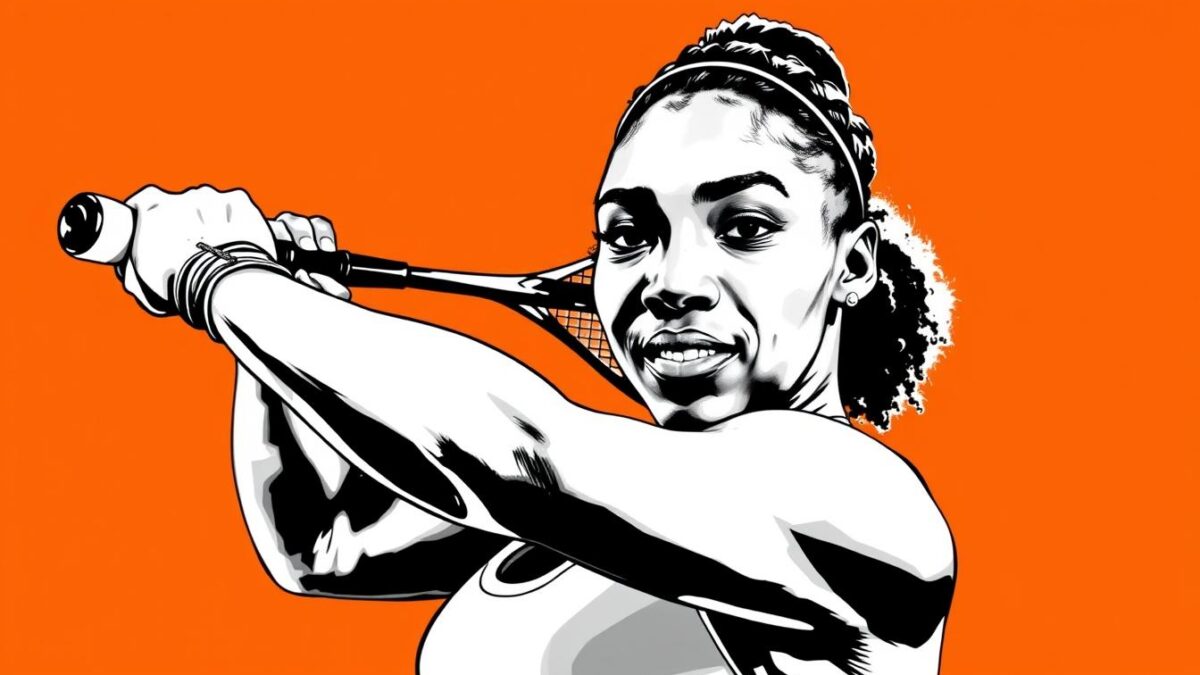
Born in Saginaw, Michigan, on September 26, 1981, this athlete’s journey began on public courts. She would become a force that reshaped her sport.
Her career is a story of sustained dominance. She held the world No. 1 ranking for 319 weeks. She finished five separate years as the top-ranked player globally.
The numbers tell part of the story. She claimed 23 major women’s singles titles, the most in the Open Era. This record cements her legacy as the greatest of her generation.
But her impact runs deeper than trophies. This female athlete revolutionized women’s tennis. She brought unprecedented power and athleticism to the game.
Serena Williams retired in September 2022 after her final U.S. Open match. She described her departure as an evolution. Her influence, however, is permanent.
She transcended the sport, becoming a cultural icon. Her journey inspires millions, proving what is possible with relentless will.
Early Life and Family Background
The foundation for a legendary career was laid not on manicured country club courts, but on the cracked asphalt of Compton, California. This environment shaped the resilience that would become a hallmark of her game.
Growing Up in Compton, California
After moving from Michigan, the family settled in Compton. It was here that a young Serena Williams first picked up a tennis racket at age four. Her father, Richard Williams, became their dedicated coach.
He taught himself the sport from books and videos. The public courts where they practiced for hours were often worn and located in a tough neighborhood. This setting forged incredible mental toughness.
The Role of Family and Coaching
Richard Williams, a former sharecropper, had a clear vision for his daughters. He home-schooled Serena and her sister Venus, controlling their development with intense focus. His unconventional methods were built on unwavering belief.
Their mother, Oracene Price, was an essential partner. She ensured discipline and education were paramount in their home. The family unit, including her half-sisters, provided a strong support system.
When Serena was nine, the family moved to Florida to attend Rick Macci’s academy. This provided professional training while Richard Williams remained the primary architect of their path to greatness.
Rise to Tennis Stardom
The junior tennis circuit witnessed something extraordinary when she entered competitive play. Serena Williams quickly established herself as unbeatable in the United States Tennis Association junior tour.
Dominance on the Junior Circuit
By age ten, Williams posted a remarkable 46-3 record. She claimed the top ranking among Florida’s under-10 players. Her powerful style set her apart from other juniors.
She hit with force and moved with speed beyond her years. This intensity previewed her future professional game.
A Strategic Pause
Her father Richard Williams made a controversial decision. He pulled both daughters from national tournaments when Serena was ten. He wanted them to develop slowly away from the spotlight.
Racism at tournaments influenced this choice. He heard derogatory comments about his daughters. This reinforced his determination to protect their path.
| Aspect | Traditional Junior Development | Williams Family Approach |
|---|---|---|
| Competitive Schedule | Constant national tournaments | Limited exposure, focused training |
| Primary Focus | Junior rankings accumulation | Long-term skill development |
| Education Priority | Often secondary to tennis | Equal emphasis with sport |
| Result | Early burnout risk | Sustainable career foundation |
This unconventional strategy created skepticism. Critics doubted players could succeed without traditional junior experience. But the Williams first approach proved visionary.
Professional Debut and Rising Success
The path to professional tennis is often rigid, but this athlete’s entry defied the established rules. Her family’s patient strategy faced its first major test against the sport’s governing bodies.
Navigating Age-Eligibility and Early Challenges
At just 14, the young tennis player planned her professional debut in Oakland. Age-eligibility rules blocked her. This sparked a brief legal challenge that was later withdrawn.
Her first actual match came weeks later in Quebec. Using a wild-card entry, she lost quickly. The result gave no hint of the power to come.
Then came a full year away from competition. The Williams family’s plan emphasized development over constant play. This patience would soon pay off dramatically.
| Factor | WTA Age-Eligibility Rules | Williams Family Strategy |
|---|---|---|
| Primary Goal | Protect youth from burnout | Control long-term development |
| Competitive Timeline | Gradual, restricted entry | Strategic, readiness-based |
| Philosophy | Institutional safeguarding | Individualized, family-led |
| Initial Outcome | Denied tournament entry | Found alternative path |
Her return in late 1997 was explosive. Ranked 304th, she stunned the tennis world in Chicago. She defeated two top-10 players back-to-back.
This made her the lowest-ranked player ever to achieve that feat. It validated her father’s unconventional training plan. Serena Williams finished the year ranked 99th, a clear signal of her arrival.
First Grand Slam Victory and Major Milestones
The year 1999 marked a seismic shift in women’s tennis as a new champion emerged from the shadows. Her breakthrough began in Paris with a first professional singles title. This signaled the arrival of a formidable talent.
The 1999 U.S. Open Triumph
At the U.S. Open, Serena Williams faced a gauntlet of Grand Slam champions. She defeated Kim Clijsters, Conchita Martínez, Monica Seles, and defending champion Lindsay Davenport. Each victory built unstoppable momentum.
The final against world No. 1 Martina Hingis showcased her dominance. She won 6-3, 7-6 with overwhelming power. At 17, she became the second African-American woman to win a Grand Slam singles title.
Historic Family Rivalries in Grand Slam Finals
The champion and her sister Venus also claimed the doubles championship. This made her the fifth woman in the Open Era to win both singles and doubles at the same major. Their partnership demonstrated remarkable versatility.
The victory announced a new era in tennis. The power game she introduced forced opponents to evolve. This first Grand Slam title felt like a coronation rather than just a beginning.
Record-Breaking Grand Slam Achievements
Across two decades of competition, her Grand Slam achievements redefined what was possible in women’s tennis. The numbers tell only part of this remarkable story.
Grand Slam Singles and Doubles Titles
Serena Williams collected 23 major women’s singles titles, the most in the Open Era. This record places her second only to Margaret Court’s all-time mark.
Her dominance extended across all four majors with balanced success. The Australian Open became her most successful tournament with seven victories.
| Grand Slam Tournament | Singles Titles | Doubles Titles (with Venus) |
|---|---|---|
| Australian Open | 7 | 4 |
| French Open | 3 | 2 |
| Wimbledon | 7 | 6 |
| US Open | 6 | 2 |
In doubles, she and her sister Venus won 14 major championships together. They never lost a Grand Slam doubles final as a team.
Career and Surface Slams
At the 2003 Australian Open, Williams completed the Career Grand Slam. She became the sixth woman in the Open Era to win all four majors.
Her 2015 season featured the rare Surface Slam. She won titles on hard court, clay, and grass in the same calendar year.
Williams achieved the “Serena Slam” twice by holding all four major singles titles simultaneously. This demonstrated sustained dominance across different playing conditions.
Dominance in the Open Era
Her reign at the top of the sport was not a fleeting moment but a sustained era of supremacy. Serena Williams held the world No. 1 ranking for 319 weeks, a staggering testament to longevity.
She finished five separate years as the year-end No. 1. This achievement highlighted her ability to dominate across different phases of a long career.
The ascent of the Williams sisters fundamentally reshaped women tennis. They ushered in a new paradigm defined by raw power and supreme athleticism.
Power and Athleticism on the Court
Her serve was a legendary weapon. Regularly exceeding 120 mph, it was a psychological and tactical advantage from the first point.
Groundstrokes combined ferocious pace with sharp precision. Her forehand and two-handed backhand could instantly turn defense into overwhelming offense.
This athlete’s physique itself became iconic. She redefined the image of a champion in women tennis, celebrating muscular strength as a primary asset.
This dominance in the open era earned unparalleled recognition. The Tennis Channel ranked her the greatest of all time.
She won a record four Laureus World Sportswoman of the Year awards. Sports Illustrated named her Sportsperson of the Year in 2015.
Her 23 major slam singles titles in the open era set a new standard for greatness. It was about more than winning; it was about transforming the game.
Notable Rivalries and Family Duels
Family bonds and championship ambitions collided in one of sport’s most compelling narratives. The Williams sisters created a dynamic that went beyond typical athletic competition.
Their matches carried emotional weight that other rivalries couldn’t match. Each encounter represented both personal and professional stakes.
The Iconic Matches Against Venus Williams
The sisters met in nine Grand Slam singles finals. Serena Williams won seven of these historic encounters.
Their first major final came at the 2001 U.S. Open. Venus Williams claimed victory in this groundbreaking match.
From 2002-2003, Serena defeated her sister in four consecutive Grand Slam finals. This remarkable stretch completed her first “Serena Slam.”
The 2017 Australian Open final saw Serena claim her record 23rd major title. Both sisters displayed incredible longevity and skill.
| Grand Slam Final | Winner | Significance |
|---|---|---|
| 2001 US Open | Venus Williams | First sisters final in Open Era |
| 2002 French Open | Serena Williams | Beginning of Serena Slam |
| 2002 Wimbledon | Serena Williams | Third consecutive major win |
| 2002 US Open | Serena Williams | Completed Serena Slam |
| 2003 Australian Open | Serena Williams | Fourth straight major victory |
Contests with Other Tennis Greats
Beyond family matches, Serena faced memorable rivalries with top players. Maria Sharapova, Justine Henin, and Victoria Azarenka each tested her skills.
The champion dominated Sharapova with a commanding head-to-head record. Matches against Henin featured particularly intense competition.
These contests defined different eras of women’s tennis. Serena consistently performed best when championships were on the line.
Impact on Women’s Tennis
Her serve wasn’t just a shot; it was a statement that echoed across the entire sport. The game of women tennis shifted fundamentally because of her presence. She introduced a level of power and athleticism that became the new standard.
Revolutionizing the Game and Inspiring Generations
Before this tennis player rose to prominence, the sport often favored finesse. Serena Williams changed that calculus with overwhelming force. Her groundstrokes and serve redefined offensive play.
She also transformed the physical ideal for a female athlete. Muscular strength became a celebrated advantage. This challenged old conventions about women’s bodies in sports.
Her success translated into unprecedented earnings. In 2016, she was the world’s highest-paid woman athlete. She repeated this feat in 2017, standing alone on Forbes’ list of top earners.
The impact reached far beyond the baseline. Young athletes like Naomi Osaka and Coco Gauff saw a path forward. They credit this champion for making them believe they belonged.
Her 23 major singles titles in the open era are a staggering record. But her true legacy is changing who can imagine themselves as a champion. She broke barriers in a predominantly white sport, proving excellence has no single form.
Serena Williams in Doubles Competition
Beyond her historic singles career, the athlete’s dominance extended powerfully into doubles competition. Teaming with her sister Venus, she forged one of the most successful partnerships in sports history.
Their connection on the court was instinctive. This bond translated into an unbeaten record in major finals.
Partnership with Venus and Unbeaten Records
The sisters captured 14 Grand Slam doubles titles together. They never lost a championship match they reached.
This perfect 14-0 record stands as the best in tennis history. It showcases their combined brilliance and unwavering trust.
Their games complemented each other perfectly. Venus’s reach at the net paired with Serena’s baseline power created an unstoppable force.
| Grand Slam Tournament | Doubles Titles Won | Years of Victory |
|---|---|---|
| Australian Open | 4 | 2001, 2003, 2009, 2010 |
| French Open | 2 | 1999, 2010 |
| Wimbledon | 6 | 2000, 2002, 2008, 2009, 2012, 2016 |
| US Open | 2 | 1999, 2009 |
Between 2009 and 2010, they held all four major doubles titles at once. This non-calendar year Grand Slam earned them the world No. 1 ranking.
Their doubles success, achieved while focusing on singles, remains a stunning achievement. It underscores their total command of the game.
Olympic Success and International Recognition
The Olympic stage provided a distinct arena for her dominance, one where national pride amplified every victory. Her success here cemented her status as a global sports icon.
Competing for the United States added another layer to her legendary career.
Golden Medals and Global Achievements
Serena Williams captured four Olympic gold medals. Three came in women’s doubles, an all-time record she shares with her sister Venus Williams.
Their first doubles gold medal victory happened at the 2000 Sydney Games. This win announced their powerful arrival on the world’s biggest sporting stage.
The duo added doubles gold again in Beijing 2008 and London 2012. This cemented their legacy as the greatest Olympic tennis partnership.
A crowning individual achievement came at the 2012 London Olympic Games. Williams earned the singles gold medal, defeating Maria Sharapova in the final.
This victory completed her Career Golden Slam in singles. This rare feat requires winning all four major Grand Slam titles plus an Olympic gold medal.
She is the only tennis player ever to achieve three Career Golden Slams. This includes one in singles and two in women’s doubles with her sister.
These Olympic achievements stand alone in the history of the sport. They highlight a versatility and dominance that transcends the standard tournament circuit.
Overcoming Injuries and Challenging Returns
A series of significant physical setbacks tested the champion’s resolve throughout her career. Her mental toughness proved as formidable as her powerful groundstrokes.
These challenges forged a legacy defined by spectacular comebacks.
Periods of Setback and Determined Comebacks
In 2003, she underwent surgery on her knee. An eight-month hiatus from the sport followed.
Her ranking eventually plummeted to a career-low of 139. Doubts about a full return surfaced.
The 2008 U.S. Open victory marked a definitive return to championship form. It began the most successful phase of her career.
A life-threatening pulmonary embolism in 2011 posed another grave challenge. Yet, she returned to win Wimbledon the following year.
After childbirth in 2017, which involved severe complications, she made a final competitive push. She reached four major finals upon her return.
| Major Challenge | Comeback Achievement | Significance |
|---|---|---|
| 2003 Knee Surgery | 2005 & 2007 Australian Open Titles | Proved ability to reclaim top form after injury |
| Ranking Drop to No. 139 | 2008 U.S. Open Victory | Largest ranking rebound to win a major |
| 2011 Pulmonary Embolism | 2012 Wimbledon Title | Overcame life-threatening health crisis |
| 2017 Childbirth Complications | Reaching 4 Major Finals (2018-2019) | Demonstrated elite competitiveness post-pregnancy |
Serena Williams’s five-year gap between number one rankings remains a record. It underscores the depth of her struggles and the historic nature of her returns.
Off-Court Ventures and Business Acumen
Beyond the baseline, the champion built a portfolio of ventures that reflect her personal values and sharp business instincts. Her success in business mirrors her athletic career, marked by strategic focus and a drive to empower others.
Entrepreneurial Pursuits in Fashion and Venture Capital
An early $12 million deal with Puma signaled her market power. This partnership laid the groundwork for future endeavors.
She later launched her own clothing line, “S by Serena,” in 2018. The brand celebrates bold aesthetics and inclusivity for all body types.
Expansion continued into beauty with a jewelry line and the 2024 launch of WYN Beauty. These ventures allowed her to engage with industries where she long served as a style icon.
Her most strategic move was founding Serena Ventures. This venture capital firm specifically funds technology startups led by women and African Americans. It directly addresses a critical funding gap in the industry.
Philanthropy and Social Initiatives
Her influence extends deeply into philanthropy. She serves as a UNICEF International Goodwill Ambassador, advocating for children’s rights worldwide.
She has opened two secondary schools in Kenya, providing transformative educational opportunities. In her hometown of Compton, she co-founded the Yetunde Price Resource Center.
This center offers vital support to victims of violence. She also sits on the board of the Billie Jean King Leadership Initiative, promoting workplace diversity and equality.
Cultural Impact and Legacy
While 23 Grand Slam titles define athletic dominance, this player’s cultural impact reshaped conversations about race, gender, and power in sports. Her influence extended far beyond the baseline, challenging long-held conventions in women tennis and society.
Breaking Barriers and Reshaping Women’s Sports
Serena Williams entered a predominantly white sport as a Black female athlete from Compton. Her powerful presence immediately challenged tennis’s country club image. She proved champions could emerge from any background with determination.
Her muscular physique and aggressive playing style confronted narrow beauty standards. This sparked important discussions about how women athletes’ bodies are judged differently based on race. Williams faced scrutiny and racism throughout her career.
She responded by winning relentlessly while refusing to conform. The tennis player used her platform to advocate for equal pay and fair treatment. Her public discussion of pregnancy complications brought attention to maternal healthcare disparities affecting Black women.
Williams was named AP Female Athlete of the Decade for the 2010s. She later received the Princess of Asturias Award for Sport. These honors recognized her global impact transcending sports.
Her legacy inspires countless young athletes who see new possibilities. She changed conversations about women’s sports, body image, and intersectional identity permanently.
Media Presence and Endorsements
Marketability rarely matches athletic greatness, but this tennis icon shattered that convention. Her commercial appeal became as formidable as her forehand.
Influencing Fashion and Popular Culture
In 2016, Serena Williams became the world’s highest-paid female athlete. She earned nearly $29 million through prize money and endorsements. The following year, she stood alone as the only woman on Forbes’ list of top earners.
Her career earnings exceeded $94 million in prize money alone. Total income from business ventures reached far beyond that figure. Major brands like Nike and Gatorade recognized her universal appeal.
The champion made fashion history in 2012. She became the first Black female athlete featured on Vogue’s cover. This acknowledged her status as both athletic champion and cultural icon.
Her bold outfit choices challenged tennis tradition. The black catsuit at the 2002 U.S. Open generated massive attention. She defended her choices and continued pushing boundaries.
In 2019, she served as a Met Gala host. This confirmed her influence extended beyond athletic apparel into high fashion. Her media presence was carefully controlled yet powerfully effective.
Serena Williams: An Iconic Journey
The numbers alone tell a story of sustained dominance across nearly three decades. Her professional career spanned from 1995 to 2022, setting standards that future generations will chase.
Maintaining Excellence On and Off the Court
Serena Williams held the world No. 1 ranking for 319 weeks. She finished five separate years as the year-end top player.
Her 73 WTA Tour-level singles titles rank fifth-most in tennis history. Victories spanned from teenage years through her late 30s.
The champion earned $94,816,730 in career prize money. This ranks first all-time among women athletes.
| Career Phase | Key Achievement | Significance |
|---|---|---|
| 1995-1999 | Professional Debut to First Grand Slam | Rapid ascent showing early dominance |
| 2000-2009 | Multiple Grand Slam Victories | Sustained excellence through prime years |
| 2010-2019 | Record-Breaking Performances | Longevity defying age expectations |
| 2020-2022 | Final Competitive Phase | Evolution into retirement with grace |
Williams competed at the highest level into her 40s. She reached major finals in her late 30s, proving commitment outweighs age.
Her career represents the complete athlete. Dominant on court, influential off it, and committed to purposes beyond personal achievement.
Influence on Future Generations
The true measure of greatness lies not just in trophies won, but in the paths cleared for those who follow. This champion’s impact created a new template for success in women tennis.
Mentoring and Inspiring New Athletes
Young players saw someone who looked like them achieving at the highest level. Naomi Osaka, Coco Gauff, and Sloane Stephens credit Serena Williams for making them believe they belonged.
Osaka has repeatedly called the tennis player her idol. Gauff’s emotional 2019 Wimbledon match with Williams felt like a torch passing moment.
American players like Madison Keys followed the power tennis blueprint Williams created. They learned that aggressive play could win championships when executed with discipline.
The champion’s advocacy led to concrete policy changes. The WTA now protects rankings for players who leave for childbirth or injury.
Young Black girls saw barriers being broken in a white-dominated sport. They learned their presence in any space was legitimate.
Williams generously offered guidance while maintaining competitive fire. Her influence extends beyond tennis to athletes in other sports.
The next generation competes in a world this icon fundamentally changed. They know greatness can come from anywhere and look like anything.
Final Reflections on a Legendary Legacy
As the curtain fell on an unprecedented tennis career, the world witnessed a graceful evolution rather than a simple retirement. Serena Williams announced her impending departure in August 2022, framing it as a transformation.
Her final match at the U.S. Open provided poetic symmetry. It was the same tournament where she won her first Grand Slam title 23 years earlier. The champion’s journey had come full circle.
Personal milestones marked her later years. She married Alexis Ohanian after giving birth to their daughter. Her autobiography “On the Line” offered insights into the mindset behind her competitive drive.
Williams continued to play at an elite level after becoming a mother. She reached four more Grand Slam finals, proving her enduring competitiveness. Her legacy extends beyond records to cultural impact.
The tennis association will forever remember her as a transformative figure. She challenged limitations and inspired generations. Her career grand achievements set a standard that may never be matched.