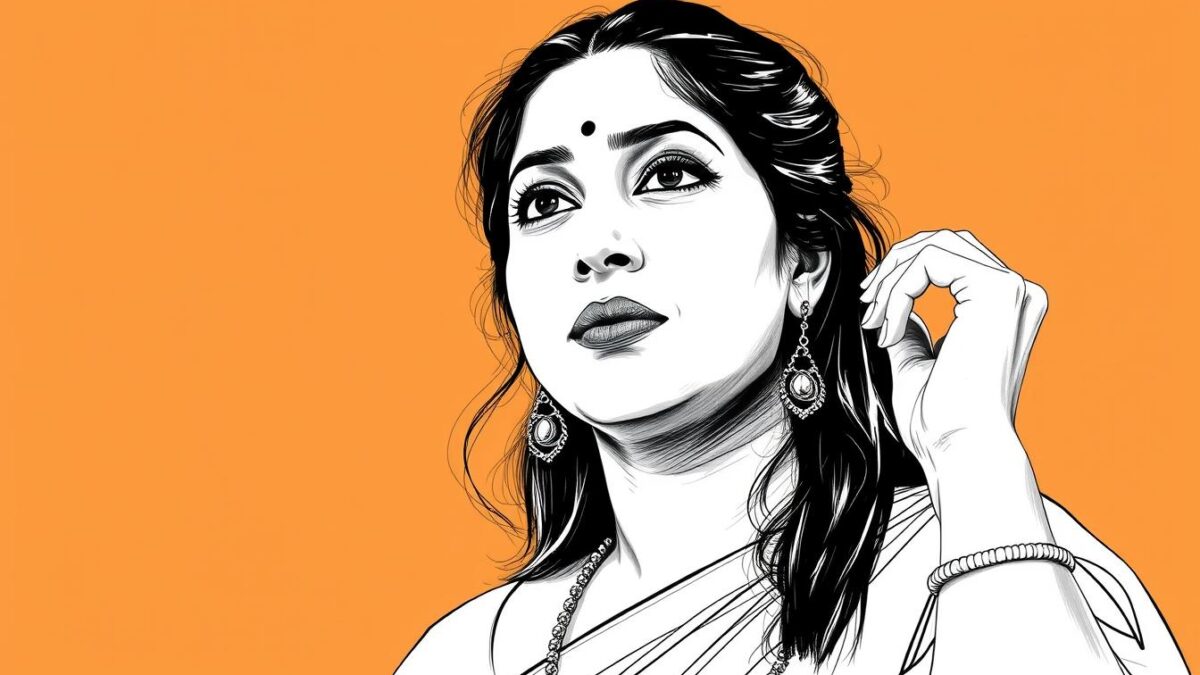
Her voice is a thread woven through the fabric of Indian cinema. From a young age, Sadhana Sargam showed a gift for melody. Born in the coastal town of Dabhol, her path was set early.
She built a legacy as a versatile playback singer. Her career spans decades and languages. She moved from chorus work to leading vocals with natural grace.
Her discipline and adaptability define her work. She has lent her voice to over 15,000 film and non-film tracks. Each song reflects a deep understanding of craft.
This journey explores the milestones of a true artist. We trace her path from early training to national awards. It is a story of respect earned through pure talent.
Introducing the Iconic Voice of Sadhana Sargam
You know her voice before you know her name. It carries a distinct warmth and clarity that cuts through the noise of a crowded industry. This signature sound built a reputation not on volume, but on melodic precision.
Her emotional restraint gives each performance a powerful intimacy. The range of this artist is remarkable. She moves from romantic ballads to devotional hymns with effortless grace.
Folk-infused tracks and classical interpretations further prove her versatility. This adaptability makes her a first choice for filmmakers and composers. They trust her consistency and professionalism across languages.
The work of Sadhana Sargam transcends the recording studio. She is a unique figure, singing for spiritual foundations and meditation albums. Her music resonates in temples, concert halls, and living rooms everywhere.
Early Life and Musical Foundations
At just four years old, she stepped onto the stage of the prestigious Sawai Gandharva festival. This early performance revealed a natural confidence that would define her career.
Family Influence and Childhood Memories
Music filled her home from the beginning. Her mother, Neela Ghanekar, was a classically trained singer with an MA in Music. She became her daughter’s first teacher.
The family created a complete musical environment. Her mother crafted a miniature tanpura for practice sessions. Her younger brother accompanied her on tabla during these early lessons.
Professional opportunities came surprisingly early. At six, she recorded “Ek Anek Aur Ekta” for Doordarshan. Composer Vasant Desai recognized her talent immediately.
Classical Training Under Pandit Jasraj and Early Performances
A Central Government scholarship at age ten changed everything. It led to seven years of rigorous training under Pandit Jasraj. This classical foundation became essential to her versatility.
Industry exposure came through chorus work in films. She sang in the children’s chorus for a track featuring Kishore Kumar. This early experience with legends like Kishore Kumar shaped her professional approach.
Vasant Desai offered crucial advice to her mother. He suggested balancing classical depth with light music versatility. This guidance became the strategic foundation for Sadhana Sargam’s entire career.
She attended A.B. Goregaonkar English School in Mumbai. Education and music training progressed together. Each element contributed to building a complete artist.
Breakthrough in Indian Playback Singing
A delayed film release created an unexpected debut scenario for an aspiring playback artist. Her first Hindi recording came earlier, but timing shaped her official entry.
The path to recognition required patience in a crowded field. Steady work built experience before the breakthrough arrived.
Debut in Vidhaata and the Rise of “Saat Saheliyan”
Subhash Ghai’s 1982 blockbuster Vidhaata served as her Hindi film introduction. The track “Saat Saheliyan” placed her alongside established stars.
Kalyanji-Anandji composed the ensemble piece. It featured the legendary Kishore Kumar and rising star Alka Yagnik. This early collaboration signaled her arrival among elite talent.
Her Gujarati film debut in Kanku Pagli showed regional versatility. But Vidhaata provided the national platform she needed.
| Year | Film | Notable Song | Composers | Significance |
|---|---|---|---|---|
| 1982 | Vidhaata | Saat Saheliyan | Kalyanji-Anandji | Official Hindi debut |
| 1985 | Rustom | Door Nahin Rehna | Bappi Lahiri | First recorded solo |
| 1986 | Janbaaz | Har Kisiko Nahin Milta | Laxmikant-Pyarelal | Breakthrough recognition |
Films like Taqdeer and Karishma Kudrat Ka filled her early years. But radio play changed everything in 1986.
“Har Kisiko Nahin Milta” from Janbaaz became the turning point. Its emotional depth showcased her melodic control. The gap between debut and breakthrough finally closed.
Exploring Iconic Bollywood Tracks and Milestones
Certain songs define an artist’s career, transcending the films they were created for. For Sadhana Sargam, the 1990s were a period of defining hits. These tracks cemented her place in the industry.
Signature Songs and Collaborations with Renowned Composers
Her duet with Udit Narayan, “Pehla Nasha” from Jo Jeeta Wohi Sikandar, remains a timeless romance anthem. The same year, “Saat Samundar Paar” became a massive dance hit. She also became the primary voice for actress Divya Bharti.
This partnership produced popular tracks like “Teri Umeed Tera Intezar.” Her ability to convey deep emotion shone in songs like “Jab Koi Baat Bigad Jaye.” Each song showcased a different facet of her vocal skill.
Collaboration with A.R. Rahman for the film Water highlighted her classical depth. Tracks like “Aayo Re Sakhi” demonstrated a spiritual power. Decades later, her work with Anu Malik on “Dard Karaara” proved her enduring appeal.
This song, a duet with Kumar Sanu, blended nostalgia with a fresh sound. It showed her unique ability to connect with multiple generations. Her voice remained a constant through changing musical trends.
Versatility Across Multiple Indian Languages
Her linguistic range extends far beyond the borders of Bollywood. This female playback singer became a voice for the entire nation.
She recorded over 15,000 tracks in 36 regional languages. This achievement showcases incredible adaptability.
Hindi, Tamil, Telugu, Bengali, and More
In Tamil cinema, Sadhana Sargam recorded more than 200 songs. Hits like “Vennilave” from Minsara Kanavu and “Snehithane” from Alai Payuthey are beloved classics.
She captured the musical essence of the South. Her nearly 100 Telugu tracks, including “Vennelave,” proved her wide appeal.
Her career spanned many linguistic markets:
- Bengali debut in 1992’s Daan Pratidan
- Memorable Odia, Kannada, and Gujarati recordings
- Work in Assamese, Nepali, and over 30 other tongues
This multilingual skill came from deep classical training. It also required respect for regional poets and composers.
She mastered pronunciation and emotion in unfamiliar languages. This earned her deep respect across India. Each song built her legacy as a truly pan-Indian playback singer.
Impact on Regional Cinema and Global Soundscapes
Director Deepa Mehta’s search for an authentic voice led her directly to Sadhana Sargam’s distinctive tone. She specifically avoided high-pitched styles common in Bollywood. Mehta preferred the artist’s lower, controlled register for its emotional depth.
This preference resulted in powerful contributions to international films. Her work in Earth (1998) and Water (2005) reached global festival audiences. These projects showcased Indian cinema beyond traditional markets.
In Water, she recorded three spiritually rich tracks. “Aayo Re Sakhi,” “Piya Ho,” and “Naina Neer” added depth to the film’s social themes. Each song reflected her classical training and emotional range.
The artist’s global reach extended to music production collaborations. UK-based producer Bally Sagoo worked with her on “Sometimes, Sometimes.” This track remixed the classic “Kabhie Kabhie Mere Dil” with electronic influences.
| Year | Project | Notable Contribution | Collaborator | Significance |
|---|---|---|---|---|
| 1998 | Earth | Film soundtrack | Deepa Mehta | International festival exposure |
| 2005 | Water | “Aayo Re Sakhi” and two other tracks | Deepa Mehta/A.R. Rahman | Critical acclaim at global festivals |
| 2000s | Sometimes, Sometimes | Remix collaboration | Bally Sagoo | Fusion of Indian melody with Western production |
| 1990s-2000s | Regional cinema | Extensive work in South Indian languages | Various composers | Pan-Asian recognition |
Regional cinema provided creative freedom beyond mainstream projects. Her work in Tamil and Telugu films gained recognition across South Asia. Markets in Sri Lanka and Malaysia embraced her versatile approach.
This playback singer explored folk and fusion styles in regional projects. These opportunities weren’t always available in Bollywood. They demonstrated her ability to transcend cultural boundaries while maintaining authenticity.
Sadhana Sargam: A Versatile Artist in the Spotlight
Professionalism and adaptability define her career, earning respect across generations of musicians. This female playback singer built a reputation on consistency and vocal control.
Her versatility extends well beyond film recordings. She performs classical concerts and devotional albums with equal commitment. Live performances across India and abroad showcase her complete artistry.
Industry legends recognize her technical skill. Lata Mangeshkar and Asha Bhosle have praised her emotional subtlety. Composers like A.R. Rahman repeatedly choose her for demanding projects.
She moves effortlessly between romantic ballads and patriotic anthems. Folk songs and spiritual hymns receive the same careful attention. This range sets her apart in a competitive field.
Sadhana Sargam maintains a busy performance schedule alongside studio work. Cultural festivals and private concerts demonstrate her live appeal. Her professionalism and punctuality are industry standards.
Younger singers look to her career as a model of sustained excellence. She adapts to changing trends without losing her distinctive identity. This playback singer represents the complete artist.
Devotional and Spiritual Contributions in Music
While Bollywood celebrated her romantic ballads, millions discovered her voice through bhajans that crossed 100 million views. Her spiritual work forms a significant part of her artistic identity.
Beloved Bhajans and Meditation Albums
The 2015 track “Sai Ram Sai Shyam Sai Bhagwan” became a cultural phenomenon. It showcases her ability to blend classical training with accessible devotion. The song’s massive YouTube success demonstrates its widespread appeal.
She collaborates regularly with spiritual organizations like Prajapita Brahmakumaris and Satya Saibaba. These partnerships produce meditation tracks and prayers used in temples nationwide. Her devotional albums span Hindi, Gujarati, and Bengali languages.
In 2011, she released “Mahalaxmi Mukti Samvad,” a spiritual dialogue album. The project featured lyrics by Dr. Pradeep Wagh. Spiritual guru Dr. Shankar Abhyankar presided over its release.
Her bhajan “O Kaanha Kaa Tohe Arpan Karun” appeared on television in 2014. This devotional work continues to reach audiences through meditation apps and spiritual gatherings. The artist’s spiritual contributions make her a voice of faith for millions.
Accolades, Awards, and Industry Recognitions
Her shelf of honors reflects a unique pattern – national acclaim for southern films, regional dominance, but curious gaps in mainstream Hindi awards.
The industry recognized her talent through prestigious honors that crossed regional boundaries. These awards document her journey from promising newcomer to established artist.
National and State Award Triumphs
In 2002, she earned the National Film Award for Best Female Playback Singer. The winning track “Paattu Solli” from Azhagi showcased her classical training. This made her the first non-South Indian singer to win this national film award for a South Indian song.
Her state film awards collection demonstrates remarkable regional impact. She received five Maharashtra State Film Awards between 1993 and 2005. Four Gujarat State Film Awards and one Orissa State Film Award further proved her linguistic versatility.
| Year | Award Category | Winning Song/Film | Significance |
|---|---|---|---|
| 2002 | National Film Award | “Paattu Solli” (Azhagi) | First non-South Indian winner for South Indian song |
| 2007 | Filmfare Award – Tamil | “Akkam Pakkam” (Kireedam) | Best Female Playback Singer recognition |
| 2007 | Filmfare Award – Telugu | “Manasa” (Munna) | Dual Filmfare South Awards in same year |
| 2003 | Star Screen Award | “Chupke Se Lag Ja Gale” (Saathiya) | Hindi film industry recognition |
Honors and Nominations that Define a Legacy
The Filmfare Awards saw historic achievements in 2007. She won both the Tamil and Telugu Best Female Playback Singer awards that year. This double victory highlighted her pan-Indian appeal.
Despite these successes, mainstream Hindi recognition remained elusive. She received only two Filmfare nominations for Hindi songs, both times losing to Alka Yagnik. This contrast between regional dominance and Bollywood near-misses defines her unique award trajectory.
Lifetime achievement honors like the Lata Mangeshkar Award celebrate her enduring contribution. The Konkan Sahyadri Swar Ratna Award acknowledges her impact on Indian music. These honors complete a picture of respected artistry across decades.
Collaborations with Legendary Music Directors
Great composers repeatedly called upon her voice. They trusted its warmth and precision. This trust built a career defined by creative partnerships.
She adapted to each director’s unique vision. Her versatility made her a favorite across genres.
Experiences with A.R. Rahman, Ilaiyaraaja, and Others
A.R. Rahman once noted his surprise with each recording session. Their work on the Water soundtrack showcased deep spiritual connection. It highlighted her classical control.
Ilaiyaraaja composed “Paattu Solli,” the track that earned her the National Film Award. He frequently selected her for Tamil and Telugu projects. Their collaboration demonstrated mutual respect.
Her partnership with Rajesh Roshan produced enduring hits like “Jab Koi Baat Bigad Jaaye.” She also worked extensively with composers like Anu Malik and Dilip Sen.
These relationships were built on professionalism. Composers knew she would deliver the required emotion.
| Composer | Notable Collaboration | Era |
|---|---|---|
| A.R. Rahman | Water soundtrack | 2000s |
| Ilaiyaraaja | “Paattu Solli” (Azhagi) | 2000s |
| Rajesh Roshan | Jurm, Kishan Kanhaiya | 1990s |
| Dilip Sen-Sameer Sen | Inteha Pyar Ki | 1990s |
| Anu Malik | Various hit soundtracks | 1990s |
She recorded the remix “Sometimes, Sometimes” with Bally Sagoo. It reimagined the classic “Mere Dil.” This showed her adaptability to modern sounds.
Duets with Alka Yagnik and Suresh Wadkar were also highlights. Each collaboration added a new layer to her vast discography.
Exploring Her Extensive Filmography and Performances
The numbers alone tell a story of remarkable productivity across India’s linguistic landscape. With over 15,000 recordings, this artist’s voice became a constant presence in homes across the nation.
Her Hindi film catalog includes more than 1,050 songs. She recorded 229 Bengali film songs and 203 Tamil tracks. The regional diversity shows deep engagement with local cinema.
| Language | Film Songs | Notable Collaborations |
|---|---|---|
| Hindi | 1,050+ | Udit Narayan, Kumar Sanu |
| Tamil | 203 | Ilaiyaraaja, A.R. Rahman |
| Bengali | 229 | Various regional composers |
| Marathi | 65 | State award-winning works |
| Telugu | 80 | Multiple hit soundtracks |
She worked extensively with composers like Dilip Sen. Each song reflected careful attention to regional nuances. Duets with Udit Narayan and Kumar Sanu became particularly memorable.
Beyond cinema, she recorded thousands of devotional albums. Titles like Gajanana and Shri Sai Mantra remain popular on streaming platforms. This devotional work complements her film recordings.
The sheer volume of songs recorded by Sadhana demonstrates incredible versatility. Her filmography spans romantic ballads to spiritual hymns. Each recording adds to her legacy as a truly pan-Indian artist.
Contribution to Indian Classical and Light Music Genres
Her musical education created a unique bridge between traditional discipline and contemporary expression. This foundation allowed her to move seamlessly between classical purity and popular appeal.
From childhood, her mother crafted a miniature tanpura for practice sessions. A Central Government scholarship at age ten led to seven years of intensive training under Pandit Jasraj. This classical grounding became the bedrock of her entire career.
Vasant Desai worked with her from early childhood on documentaries and stage shows. He advised her mother that she could master both classical and light music forms. This guidance shaped her artistic trajectory profoundly.
The rigorous training enabled her to handle complex compositions by masters like Ilaiyaraaja. Her classical background brought depth to every film song she recorded. This versatility distinguished her from purely commercial playback singers.
Even when singing alongside legends like Kishore Kumar, her classical foundation shone through. She recorded ghazals and bhajans that showcased her traditional training. Sadhana Sargam proved that classical roots could enhance rather than limit popular success.
Influence on Contemporary and Emerging Playback Singers
When younger singers name their influences, Sadhana Sargam’s name consistently appears alongside the industry’s most respected voices. Artists like Sunidhi Chauhan and Shashaa Tirupati cite her as an inspiration for balancing technical skill with emotional authenticity.
Her low-pitched, melodic style offered an alternative to the high-pitched dramatic voices that once dominated Bollywood. This tonal diversity influenced composers to explore different vocal textures in their compositions.
In the early 1990s, she competed alongside Kavita Krishnamurthy, Alka Yagnik, Anuradha Paudwal, and Poornima. This period represented a golden era for female playback singing in Indian cinema.
Legends like Lata Mangeshkar and Asha Bhosle praised her technical precision and emotional restraint. Their endorsement gave her credibility that crossed generational divides.
She mentored younger singers through her professional example rather than formal teaching. Her punctuality and adaptability became industry standards that emerging artists still emulate today.
The Digital Transformation of a Musical Icon
The streaming era opened a new chapter for a voice already familiar to millions. Digital platforms introduced her artistry to a younger generation. This shift cemented her status as a timeless performer.
YouTube Milestones and Social Media Impact
Her 2015 devotional track became a viral phenomenon. “Sai Ram Sai Shyam Sai Bhagwan” soared past 100 million YouTube views. This achievement made her a devotional music icon for the digital age.
The song’s massive success bridged generational gaps. Listeners who missed her 1990s film hits discovered her voice anew. Streaming services like Spotify and Apple Music kept her entire catalog accessible.
In June 2021, she joined forces with A.R. Rahman and poet Gulzar. They created “Meri Pukaar Suno,” a healing anthem for challenging times. The track featured an ensemble of six other celebrated vocalists.
Rolling Stone India praised the song as a heartfelt piece of healing. Director Nazeef Mohammed’s video showcased all seven artists in a powerful digital collaboration. Fan pages and devotional channels continue to amplify her work across social media.
This successful adaptation to the digital landscape proves her enduring relevance. Data retrieved in August 2021 confirmed her sustained online presence. Her music continues to find new audiences decades after its original release.
An In-Depth Look at Her Rich Discography
Her discography reads like a map of India’s musical landscape, spanning regional boundaries and genres. Fifteen thousand recordings in 36 languages demonstrate incredible reach.
The Hindi film catalog includes 1,050 songs. Hits like “Main Teri Mohabbat Mein” from Tridev showcase her romantic range. “Teri Mohabbat” remains a fan favorite across multiple films.
She recorded extensively with composer Dilip Sen in the early 1990s. Their collaborations highlighted her emotive depth. The partnership produced memorable tracks that defined an era.
| Language | Song Count | Notable Work |
|---|---|---|
| Hindi | 1,050+ | “Main Teri Mohabbat Mein” |
| Bengali | 229 | “Premi O Premi” |
| Tamil | 203 | “Deewana Deewana” |
| Telugu | 80 | Various hit soundtracks |
| Marathi | 65 | Award-winning compositions |
Duets with Suresh Wadkar added harmonic richness to her catalog. Collaborations with Alka Yagnik created memorable ensemble pieces. Each partnership expanded her artistic range.
Devotional albums like Gajanana and Shri Sai Mantra represent significant non-film work. These spiritual recordings appeal to audiences across India. They complement her extensive film contributions.
The Tamil track “Deewana Deewana” from Gemini earned critical praise. It demonstrated her ability to adapt to southern musical styles. This versatility defines her entire recorded legacy.
A Glimpse into Sadhana Sargam’s Personal Journey and Legacy
The story of Sadhana Sargam’s career is deeply intertwined with her personal history and relationships. Born as Sadhana Ghanekar in Dabhol, Maharashtra, her musical foundation began at home.
Her mother Neela Ghanekar provided classical training from childhood. A miniature tanpura crafted for practice sessions showed early dedication. Her younger brother accompanied her on tabla during formative performances.
She often credits Ilaiyaraaja for composing the National Award-winning song that elevated her career. This gratitude reflects how collaborations shaped her path.
In 2017, she reunited with Udit Narayan for the nostalgic title track of Yeh Un Dinon Ki Baat Hai. The song became an instant hit with audiences. This dinon baat hai collaboration showed her enduring appeal.
| Year | Personal Milestone | Key Collaboration | Significance |
|---|---|---|---|
| 1969 | Born in Dabhol, Maharashtra | Family musical tradition | Foundation for career |
| 2017 | Yeh Un Dinon Ki Baat Hai title track | Udit Narayan | Nostalgic TV serial success |
| June 2021 | “Meri Pukaar Suno” ensemble project | A.R. Rahman, Gulzar | Continued relevance demonstration |
| Throughout career | Romantic hits like “Kuch Naa Kaho“ | Various partners including Suresh Wadkar | Balance of solo and duet work |
Her June 2021 collaboration with A.R. Rahman featured six other prominent singers. Tracks like “Kuch Naa Kaho” and “Tera Mera Pyar” maintained her romantic appeal. Each yeh dinon baat project revealed new dimensions of her artistry.
This personal journey shows how roots and relationships created an enduring legacy. Family support and professional connections shaped one of India’s most respected voices.
A Reflective Look at the Enduring Impact of Her Melodious Career
Four decades of melody have carved a legacy that defies simple categories. The career of Sadhana Sargam stands as a testament to persistence and the power of a voice that transcends region.
She made history as the first non-South Indian singer to win a National Award for a South Indian song. In 2007, she again broke barriers by winning two Filmfare South Awards for best female playback singer in the same year, for tracks like “Akkam Pakkam.”
This regional dominance contrasts with her journey in Hindi cinema. Despite over 2,000 songs, a Filmfare Award for a Hindi track remained elusive. Yet, her mastery shone in award-winning Marathi songs like “Saanjh Jhali Tari.”
Her impact continues to resonate. Collaborations as recent as June 2021 prove her enduring relevance. This female playback artist’s disciplined craft leaves a lasting imprint on Indian music.