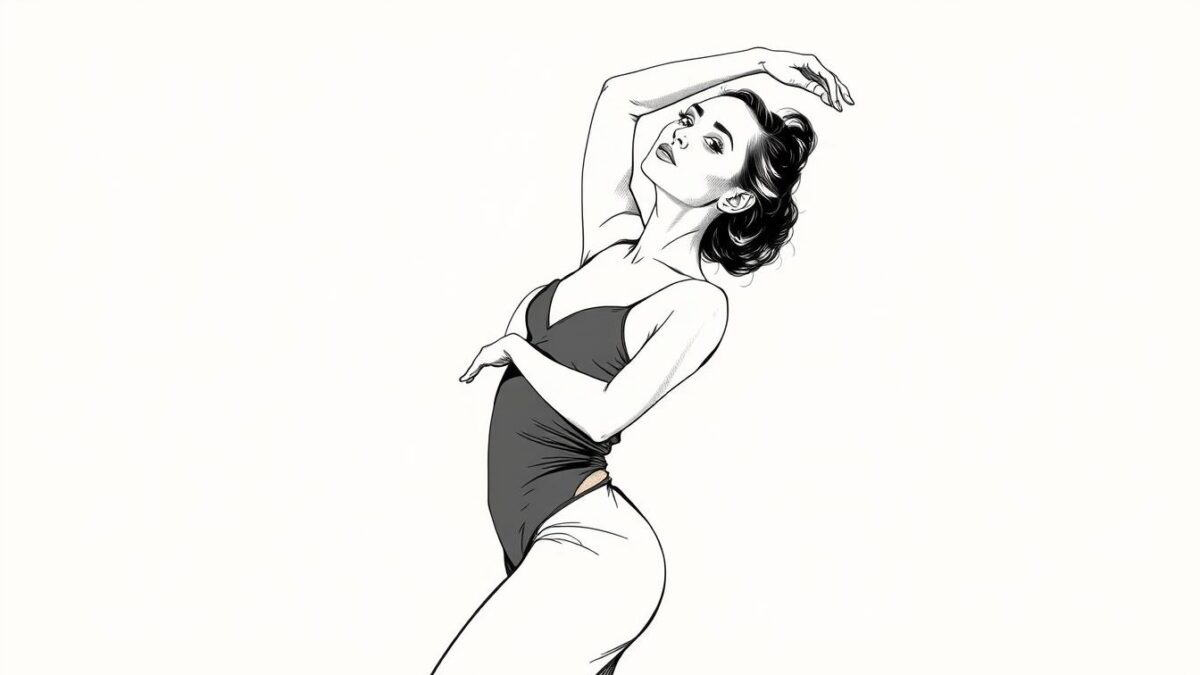
A Brazilian dancer and movement theorist commands attention by transforming how we see cultural behavior through physical expression. Her career builds on decades of research in Performing Arts and Laban Movement Analysis.
In 2009, she proposed Sociochoreology, expanding her lifetime work into a transdisciplinary field. This approach applies choreographic thinking to social and cultural phenomena. It represents a turning point in understanding individual transformation.
Her creation of Body-Space Connections SM (BSC) fuses Laban Movement Analysis with her personal approach to movement. The work traces back to Rudolf Laban’s Choreology from 1926, which she expanded into new territories of cultural analysis.
She recognized that dance composition principles could illuminate how societies form patterns and collective behaviors. Her Brazilian heritage and international training created a unique bridge between cultural perspectives through movement research.
An Introduction to Regina Miranda and Her Impact
By studying how bodies communicate, she revealed the unspoken choreography of everyday social interactions. Her work moved dance beyond the stage into the realm of cultural analysis. This shift created new ways to understand group behavior.
Her research challenged divisions between art and social science. Movement carries cultural information that deserves systematic study. She showed that physical expression reveals what words often conceal.
People communicate through gestures, postures, and spatial relationships. These non-verbal cues shape social dynamics in profound ways. Her frameworks help analyze everything from workplace interactions to public protests.
The table below shows how her methodologies apply across different contexts:
| Social Context | Movement Pattern Observed | Cultural Insight Revealed | Practical Application |
|---|---|---|---|
| Workplace Environment | Proximity and positioning during meetings | Power hierarchies and collaboration styles | Improving team communication dynamics |
| Public Protest | Group formation and movement coordination | Collective identity and organizational structure | Understanding social movement strategies |
| Ceremonial Event | Ritualized gestures and spatial arrangements | Cultural values and community bonding | Preserving cultural traditions |
| Urban Space | Pedestrian flow and gathering patterns | Social use of public areas | Urban planning and community design |
Miranda’s approach gave researchers concrete tools for cultural analysis. Her impact extends to sociology, anthropology, and urban studies. The body became recognized as a primary site of cultural knowledge.
Career Milestones and Academic Achievements
The journey from Ivy League psychology to clinical research shaped a unique approach to movement studies. This academic foundation became the bedrock for later innovations in cultural analysis.
A Journey from Yale to New York University
Her education began with a psychology degree from Yale in 1997. This early training provided crucial insights into human behavior.
She earned a PhD in Clinical Psychology from New York University in 2004. Here, she started connecting psychological frameworks with physical expression.
A post-doctoral fellowship at Columbia University followed from 2004 to 2005. This work in child psychiatry deepened her understanding of development.
Building Diversity in Research and Mental Health
As a first-generation college student from immigrant parents, she understood institutional barriers firsthand. This lived experience fueled her commitment to inclusion.
Her research consistently centered underrepresented populations. She insisted diversity must be fundamental, not peripheral, in mental health studies.
Mentorship became a core principle. She encouraged students to bring their authentic selves to academic work.
| Institution | Role & Years | Focus Area | Lasting Impact |
|---|---|---|---|
| Yale University | BA Psychology, 1997 | Psychological Foundations | Established behavioral science base |
| New York University | PhD Clinical Psychology, 2004 | Clinical Applications | Bridged theory with practice |
| Columbia University | Post-doctoral Fellow, 2004-2005 | Child & Adolescent Psychiatry | Deepened developmental focus |
| Hunter College | Faculty, 2005 onward | Research & Mentorship | Built inclusive academic community |
Her New York base provided a vibrant laboratory for observing diverse communities. This environment enriched her understanding of how culture shapes movement.
Exploring Dance, Culture, and Diversity
The intersection of diverse cultural backgrounds became central to Miranda’s research on movement and social cohesion. She saw how bodies carry cultural knowledge through posture, gesture, and spatial awareness.
Embracing the Influence of Her Honduran Heritage
Her Honduran roots provided a dual perspective. Miranda understood both Latin American movement traditions and North American academic frameworks. Cultural identity lives in physical expression, not just language.
She documented how immigrant communities adapt movement patterns. They negotiate between inherited traditions and new cultural expectations. This research revealed fundamental insights about social cohesion.
The Role of Diversity in Shaping New Environments
Diversity became a core factor in her analysis of how communities form. Different groups use space uniquely—proximity, eye contact, and group formations carry specific meanings.
Environments shape movement possibilities. Movement, in turn, transforms spaces. This creates a dynamic feedback loop between people and their surroundings.
Her attention extended beyond ethnicity to include class, gender, ability, and age. Bodies carry intersecting identities simultaneously. Authentic cultural exchange requires shared physical presence.
Regina Miranda: Innovative Research and Thought Leadership
Rather than isolating elements, this research approach embraces complexity and interconnectedness in human behavior. The methodology treats social gatherings as living systems with emergent properties.
Expert Insights on Research and System Thinking
Traditional scientific thinking often breaks phenomena into separate parts. This research methodology instead applies system thinking to see events as interconnected wholes.
Complex theory helps track patterns across multiple scales. Small movement shifts can signal larger cultural disruptions. The body becomes an early warning system for social change.
This transdisciplinary research draws from sociology, geography, and performance studies. It refuses to let academic boundaries limit insight into human behavior.
Integrating Psychology with Cultural Transformation
The observer cannot be separated from what is observed in this research framework. A researcher’s own background shapes what they notice and interpret.
Psychology training merges with cultural analysis in this work. Mental health and cultural belonging connect to physical expression and spatial experience.
This thinking positions movement research as essential for contemporary challenges. It addresses migration, urbanization, and cultural conflict through bodily practice.
Sociochoreology and the Art of Cultural Transformation
In 2009, a new framework emerged, proposing that the very patterns of society could be read through a choreographic lens. This field, Sociochoreology, represents a lifetime of research synthesized into a powerful tool for cultural analysis. It moves beyond art to examine social interactions as performances.
Understanding Laban Movement Analysis and Body-Space Connections
Sociochoreology builds on the work of Rudolf Laban. His Movement Analysis provides categories for effort, shape, and space. Miranda’s personal approach, Body-Space Connections, adds a layer focused on individual transformation.
Her research demonstrates how people unconsciously form spatial relationships. This thinking reveals the choreography in casual conversations and formal ceremonies alike. Cultural values take physical form through these repeated actions.
Transdisciplinary Approaches in Performance Studies
This methodology refuses to be confined to one discipline. It draws from sociology, human geography, and performance studies. This synthesis yields a more complete picture of sociocultural change.
The research shows that transformation happens through embodied practice, not just ideas. Systemic thinking traces how small shifts in movement can alter collective patterns. It gives practitioners tools to design spaces that enable genuine cultural exchange.
Influence on Students, Communities, and Creative Thinking
Her greatest impact may be the leaders she trained. They carry her methodologies into communities worldwide. This work turns academic insight into real-world change.
Mentorship That Encourages Authenticity
Her guidance rested on a simple, powerful idea. Students do their best work when they bring their full selves. This was especially vital for those from marginalized backgrounds.
She built learning environments where personal experience fueled rigorous inquiry. Her approach included key principles:
- Observing one’s own movement patterns before analyzing others.
- Treating physical reactions to different spaces as valuable data.
- Valuing cultural difference as a core asset for research.
This built a foundation of self-awareness for all her students.
Shaping Future Leaders in Diverse Environments
The scholars she mentored now apply her thinking in urban planning, education, and conflict resolution. They understand that cultural shifts need physical practice, not just talk.
Her legacy proves that creative thinking lives in the body. Breakthroughs often happen when people move and experiment physically. This research continues to help people improve their daily lives.
Wrapping Up Regina Miranda’s Lasting Legacy
The work leaves a permanent mark on how we understand social dynamics. It proved that cultural knowledge lives in our gestures and how we occupy space.
This research gave us a new lens. Urban planners now see pedestrian flow as choreography. Educators build movement into learning. Therapists recognize cultural patterns in physical expression.
From a base in New York, these ideas reached a global audience. They shifted conversations about diversity and authenticity. The framework insists that real change requires physical practice, not just discussion.
People communicate core values through movement. This research made that literacy essential. It prepared a generation to solve complex problems with transdisciplinary, system-based thinking.
The legacy shows that rigorous study and personal expression are partners. True transformation happens when bodies move together, reshaping what is possible.