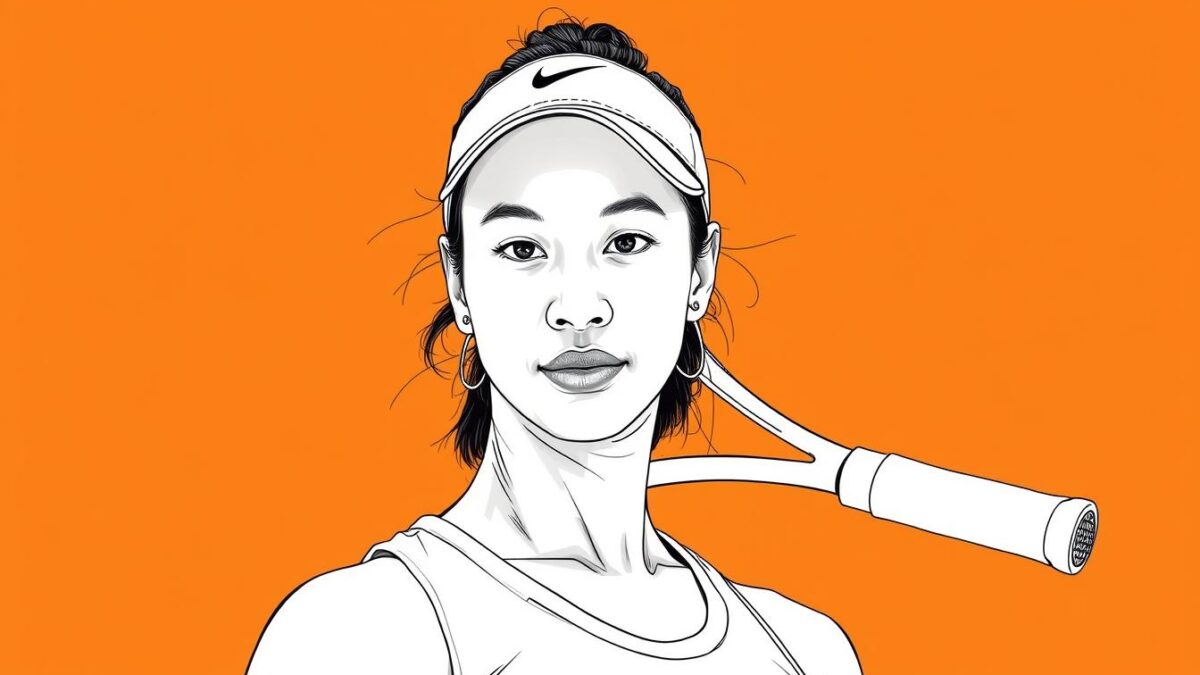
Her story rewrote the record books before she turned twenty-five. Naomi Osaka stands as one of tennis’s most transformative figures. She became the first Asian player to hold the world No. 1 ranking in singles.
Her power on the court secured four Grand Slam titles. She captured two US Open and two Australian Open championships. This player won each of her first four major finals, a rare feat.
Born in Japan, she moved to the United States at age three. She grew up training on public courts in Florida. Her journey reflects a complex identity, representing Japan on the global stage.
Her impact stretches far beyond match points. She became one of the world’s most recognizable athletes. Her voice sparked vital conversations about mental wellness and public scrutiny.
Early Life and Cultural Heritage
From Japan to New York’s Long Island, her formative years spanned oceans and cultures. This unique background would shape both her identity and career path from the very beginning.
Childhood in Japan and the United States
Born in Osaka, Japan, she moved to the United States at age three. Her family settled in Elmont, New York, living with her father’s parents on Long Island.
When she was about eight years old, another relocation brought the family to Florida. This move provided better tennis training opportunities on public courts in Pembroke Pines.
Family Background and Cross-Cultural Influences
Her parents represented a blend of Haitian and Japanese heritage. Her mother came from Nemuro, Hokkaido, while her father hailed from Jacmel, Haiti.
The sisters took their mother’s family name following Japanese custom. This decision reflected their cultural roots and influenced her choice to represent Japan internationally.
Her father found inspiration watching Venus and Serena Williams at the 1999 French Open. He decided to coach his daughters using Richard Williams’ successful blueprint as his guide.
Path to Professional Tennis
Her professional journey began not on the junior circuit, but directly against seasoned adults. Most players spend years in junior tournaments. She skipped that stage entirely.
Transition from Junior to Professional Circuit
On her 14th birthday, she played her first qualifying match on the ITF Women’s Circuit. This bold move set the tone for her entire career. She faced professionals from the start.
Her first main-draw appearance came in doubles with her sister months later. Qualifying for a singles draw proved tougher. It took seven attempts that same year.
She competed on the ITF Circuit for several years without a title win. She reached four finals but never claimed the top prize. This period built her resilience.
At 15, she began formal coaching with Patrick Tauma. This started a pattern of seeking new training environments. She later moved to the Harold Solomon and ProWorld Tennis academies.
She officially turned professional in September 2013, just before turning 16. This commitment locked her into the demanding world tour schedule. Her unconventional path was now fully set.
Breakthrough Moments on the WTA Tour
The professional tour first felt her power in 2014 at a small California tournament. A 16-year-old qualifier, ranked 406th in the world, stepped onto the court for her very first WTA level match. She faced a former US Open champion.
First Major Wins and Pivotal Matches
In that debut, Osaka upset world No. 19 Samantha Stosur. The victory was a dramatic comeback. She saved a match point and rallied from a 5-3 deficit in the final set.
This first WTA win showcased incredible mental toughness. It was a trait rarely seen in someone so young. The match proved she could handle high-pressure situations against elite players.
Later that year, she won the Rising Stars Invitational. Defeating another heavily favored opponent signaled her potential to tennis insiders.
Debut Highlights and Rising Recognition
The 2016 season cemented her status as a rising star. She qualified for her first Grand Slam main draw at the Australian Open. Osaka advanced to the third round that year.
A straight-sets victory over No. 21 Elina Svitolina in the second round was key. It confirmed the Stosur win was no fluke. She could consistently compete at the highest level.
The WTA recognized this rapid ascent. They named her the 2016 Newcomer of the Year. This honor validated her unconventional path to the professional circuit.
Major Grand Slam Triumphs and Career Milestones
Four major titles in three years defined a period of dominance that reshaped women’s tennis. Each victory carried unique significance beyond the trophy.
Historic Wins at the US Open and Australian Open
The 2018 US Open marked a breakthrough. Naomi Osaka defeated Serena Williams to claim her first Grand Slam title. She became Japan’s first major singles champion.
That New York final was overshadowed by controversy. Yet the young player maintained remarkable composure throughout the chaotic match.
Just months later, she captured the 2019 Australian Open. This victory made her the first Asian player to reach world No. 1. She saved three championship points against Petra Kvitová in a dramatic final.
The 2020 US Open showcased her resilience. She rallied from a set down against Victoria Azarenka. Her third slam title came with powerful social statements.
At the 2021 Australian Open, she secured her fourth major. The straight-sets win over Jennifer Brady completed an incredible statistic. She joined Monica Seles in winning her first four Grand Slam finals.
| Tournament | Year | Opponent | Score | Significance |
|---|---|---|---|---|
| US Open | 2018 | Serena Williams | 6-2, 6-4 | First Japanese Grand Slam champion |
| Australian Open | 2019 | Petra Kvitová | 7-6, 5-7, 6-4 | Reached world No. 1 ranking |
| US Open | 2020 | Victoria Azarenka | 1-6, 6-3, 6-3 | Third slam title with social impact |
| Australian Open | 2021 | Jennifer Brady | 6-4, 6-3 | Won first four major finals |
These consecutive triumphs established Osaka as a dominant force. Each victory demonstrated different aspects of her championship mentality.
Naomi Osaka: Road to the Top
The climb to the summit of professional tennis is a grueling ascent, but her path was uniquely meteoric. It began in earnest at the 2018 Indian Wells Open. There, she captured her first Tour-level title, a win that announced her arrival among the elite.
That tournament run was a statement. She defeated Karolína Plíšková and, crucially, world No. 1 Simona Halep. The victory over Halep marked her first time beating a current top-ranked player.
This success propelled her up the WTA rankings. By October 2018, after a strong showing at the China Open, she climbed to a career-best world No. 4. This ranking matched the historic high for a Japanese player, a record shared with Kimiko Date and Kei Nishikori.
Her first major title at the US Open later that year set the stage for the final leap. The ultimate goal was now within reach.
Following her 2019 Australian Open victory, she secured the world No. 1 ranking for the first time. This made her the first Asian player to hold the top spot in singles. She maintained that No. 1 ranking for 25 weeks, cementing her status at the pinnacle of the sport.
Navigating Career Challenges and Comebacks
Every champion’s path includes moments where progress stalls and the body rebels. For Naomi Osaka, the 2017 season was such a time. Her ranking hovered steadily, unable to break past a career-high, signaling a plateau that tested her patience.
This period revealed a recurring mental hurdle in major matches.
Handling Setbacks and Injuries
Physical issues repeatedly interrupted her momentum. An abdominal injury forced a retirement at the 2017 Canadian Open, a frustrating end after winning the second set.
The following season, a hamstring problem cut her 2018 WTA Finals short. Another abdominal issue led to a withdrawal after a strong semifinal run in Stuttgart the next year.
A right hand injury also sidelined her from the Italian Open that same season. These setbacks taught crucial lessons in recovery and schedule management.
Resilience in High-Pressure Situations
Closing out tight matches proved difficult early on. At the 2016 US Open, a 5-1 lead in the third set vanished against Madison Keys, ending in a tiebreak loss.
The pattern continued the next year in the same tournament’s third round. A break lead in the final set against Kaia Kanepi slipped away, marking a second consecutive early exit.
These losses, while painful, built the mental toughness required for her later Grand Slam triumphs. Each challenge forged a stronger competitor.
Signature Playing Style and On-Court Tactics
Her approach to tennis was built on a foundation of explosive power and strategic aggression. This player developed a game that overwhelmed opponents before they could establish rhythm.
Aggressive Serve and Powerful Game
Naomi Osaka’s serve became one of her greatest weapons, reaching speeds of 201 kilometers per hour. She used this powerful delivery to control points from the start.
Her right-handed, two-handed backhand generated tremendous pace from both wings. This aggressive baseline style proved particularly effective on hardcourts.
Strategic Play and Mental Toughness
Osaka’s game plan centered on first-strike tennis. She aimed to take control early in each match rather than engaging in long rallies.
Her mental toughness shone in crucial rounds. The athlete often raised her level when facing top players in important sets.
This combination of physical power and clutch performance made her especially dangerous in Grand Slam settings. Her ability to hit winners from defensive positions set her apart.
Influence Beyond the Tennis Court
Her platform became a megaphone for social justice, transforming tennis courts into stages for activism. The athlete’s influence reached far beyond sports during pivotal moments in the United States.
Activism and Social Impact
During the 2020 US Open in New York, she made a powerful statement before each match. She wore face masks bearing names of Black Americans affected by racial violence. This symbolic gesture accompanied her championship run.
Her activism extended to tournament withdrawals that forced the tennis world to confront social issues. After withdrawing from the Cincinnati Open semifinals, organizers postponed play for a day. This demonstrated her ability to influence decisions at the highest level.
Time magazine recognized her global impact by including her on their influential people list three consecutive years. Sports Illustrated named her a 2020 Sportsperson of the Year specifically for her activism.
At the Tokyo Olympics, she became the first tennis player to light the Olympic cauldron. This honor reflected her status as a global figure. Her willingness to speak on mental health and social justice inspired athletes worldwide.
Training Regimens and Coaching Evolutions
The evolution of a champion’s training often tells as compelling a story as their tournament victories. Coaching partnerships have consistently marked turning points throughout Naomi Osaka’s career.
The Role of Family Coaching and Mentorship
Her tennis foundation began with family guidance. Leonard François developed his coaching approach by studying the Williams sisters’ training methods.
This self-taught approach built powerful games on Florida’s public courts. The athlete later sought professional coaching at age fifteen.
Patrick Tauma at the ISP Academy provided her first external training structure. She then moved to the Harold Solomon Tennis Academy in 2014.
The most significant coaching change came before the 2018 season. Sascha Bajin’s arrival sparked an incredible period of success.
| Coach | Period | Key Achievements | Transition Reason |
|---|---|---|---|
| Leonard François | Formative Years | Developed power game foundation | Initial family coaching |
| Patrick Tauma | Age 15 | First professional structure | Seeking formal training |
| Sascha Bajin | 2018-2019 | 2 Grand Slams, World No. 1 | Career breakthrough needed |
| Leonard François | 2019-2021 | US Open, Australian Open titles | Return to familiar guidance |
| Tomasz Wiktorowski | 2022-Present | Current coaching partnership | Seeking new direction |
These coaching evolutions reflect a pattern of strategic changes. Each transition responded to specific career needs and personal dynamics.
Impact of Injuries on Performance and Career
The pattern of injury interruptions has defined significant chapters in her competitive journey. Physical setbacks repeatedly disrupted momentum during crucial tournament runs.
A hamstring injury forced retirement at the 2018 WTA Finals, abruptly ending that breakthrough season. This came just after Naomi Osaka’s first major victory at the US Open.
The following year brought more challenges. An abdominal injury caused withdrawal from the Stuttgart Grand Prix semifinals. Shortly after, a right hand injury sidelined her from the Italian Open.
These recurring issues created a frustrating cycle. Strong performances were often interrupted by forced breaks. The abdominal problem proved particularly persistent across multiple seasons.
In 2022, she withdrew before her Melbourne 250 semifinal with another abdominal injury. The pattern continued into 2025 when the same issue forced withdrawals from Auckland and the Australian Open.
Managing these physical limitations while maintaining competitive fitness remains a defining career challenge. The balance between performance and preservation continues to shape scheduling decisions.
Mental Health and Its Role in Her Journey
A watershed moment for mental health awareness in athletics unfolded during the 2021 French Open. The athlete’s decision to prioritize psychological wellness over professional obligations sparked global conversation.
Balancing Public Pressure and Personal Well-Being
Before the tournament began, Naomi Osaka announced she would skip mandatory press conferences. She cited mental health concerns, calling the format detrimental to athlete wellness.
French Open organizers responded with a $15,000 fine after her first-round match. They threatened escalating penalties and potential disqualification if she continued avoiding media duties.
Rather than comply, the tennis star withdrew from the competition entirely. Her statement revealed struggles with depression since her 2018 US Open victory.
The withdrawal extended through Wimbledon as she took a mental health break. This period away from competition allowed for necessary recovery and reflection.
| Event | Stakeholder | Response | Impact |
|---|---|---|---|
| Press Conference Announcement | Athlete | Cited mental health concerns | Initial controversy |
| First-Round Fine | Tournament Organizers | Financial penalty imposed | Escalated conflict |
| Tournament Withdrawal | Athlete | Prioritized psychological health | Global dialogue sparked |
| Public Reaction | Media & Fans | Mixed support and criticism | Industry standards questioned |
This courageous stand helped destigmatize mental health challenges among elite competitors. It fundamentally changed how athletes approach media obligations and self-care.
The decision to withdraw citing mental health needs represented a significant shift in sports culture. It empowered other athletes to prioritize their psychological well-being.
Legacy in American and Global Tennis
Some careers are defined by records, while others redefine what’s possible. Naomi Osaka’s impact stretches far beyond her four Grand Slam titles. She opened doors for Asian players in a sport long dominated by Western athletes.
As the first Japanese player to win a major singles title, she shattered barriers that stood for decades. Her rise to world No. 1 made her the first Asian player to reach that summit. This achievement inspired young tennis players across Japan and throughout Asia.
The Women’s Tennis Association recognized her influence early, naming her 2016 Newcomer of the Year. With seven career singles titles, she established herself among the elite champions of her generation.
Her willingness to speak about mental health changed conversations within the tennis association. Osaka’s activism brought new audiences to women’s tennis. Fans connected with her values beyond athletic achievements.
The 2021 Laureus World Sportswoman of the Year award acknowledged her global impact. She proved players could maintain authentic identities while competing at the highest level. Her legacy remains that of a champion who prioritized wellness and justice.
Marketability, Branding, and Off-Court Persona
Authenticity proved more valuable than perfection in building her commercial empire. The tennis champion’s marketability extended far beyond Grand Slam titles.
Endorsements, Sponsorships, and Media Influence
Naomi Osaka became one of the world’s most marketable athletes. Her brand attracted sponsors across multiple industries beyond sports.
In 2020, she ranked eighth globally in endorsement income among all athletes. That same year, she earned the highest annual income ever recorded by a female athlete.
Her appeal stemmed from multiple factors. Grand Slam success combined with youth and multicultural identity created unique market value.
Social media savvy and willingness to engage with social issues amplified her influence. Brands recognized her cross-demographic appeal.
She finished 2018 as WTA Tour prize money leader with nearly $6.4 million. Endorsement income soon dwarfed her on-court earnings.
Major partnerships included Nike and Nissan among others. These deals reflected her global reach and commercial power.
Interests in fashion, gaming, and photography created additional revenue streams. These hobbies expanded her brand beyond traditional tennis sponsorships.
Unlike previous stars who managed public personas carefully, Osaka embraced social media authenticity. She shared struggles alongside triumphs.
Her brand weathered controversies like the French Open withdrawal. Authenticity ultimately strengthened fan connections and sponsor loyalty.
Osaka demonstrated that athletes could build powerful brands by being themselves. She rejected sport’s traditional media-trained expectations.
Managing Maternity Breaks and Post-Retirement Transitions
The return from maternity leave presents a unique challenge in professional sports. It tests both physical conditioning and personal priorities on a grand scale.
Naomi Osaka announced her pregnancy just before the 2023 Australian Open. She gave birth to her daughter, Shai, in July of that year.
This created a fifteen-month break from competition. Questions about her ability to return to elite form were natural.
Return to Competition after Maternity Leave
Her comeback began in early 2024. The athlete faced the immediate task of regaining match sharpness without protected ranking status.
Results were solid but showed room for growth. She reached quarterfinals in Doha and ‘s-Hertogenbosch.
She also advanced to the round of 16 in Rome and Beijing. These performances proved she could still compete at a high level.
A first-round loss at the Paris Olympics was a setback. The 2025 season, however, brought renewed promise.
Osaka played her best tennis in years to reach the Auckland final. Unfortunately, a recurring abdominal injury forced a withdrawal from that match.
The same issue caused her to miss the first round of the Australian Open. This injury continued to challenge her comeback efforts.
| Year | Tournament | Result | Significance |
|---|---|---|---|
| 2024 | Doha | Quarterfinal | Strong initial comeback |
| 2024 | Rome | Round of 16 | Competitive against top players |
| 2024 | Olympics Paris | First Round | Disappointing early exit |
| 2025 | Auckland | Final (WD) | Best form in years, injury |
Balancing motherhood with the tour’s demands adds a complex layer. Her commitment to returning demonstrates a champion’s enduring drive.
Final Reflections on Naomi Osaka’s Journey
From Florida’s public courts to the world’s biggest stages, one player’s journey redefined modern tennis. Naomi Osaka captured four Grand Slam titles, winning each of her first four major finals. This remarkable achievement placed her among the sport’s elite champions.
Her 25 weeks at world No. 1 made history as the first Asian player to reach that ranking. The athlete’s two Australian Open victories showcased her dominance on hard courts. But her legacy extends far beyond statistics and trophies.
Osaka transformed conversations about mental health and athlete autonomy. Her quiet personality contrasted with powerful social statements. This authenticity created a new template for modern sports figures.
At 28, her story remains unfinished. Whether she adds more titles or not, her impact is secure. The champion proved excellence and vulnerability can coexist at the highest level.