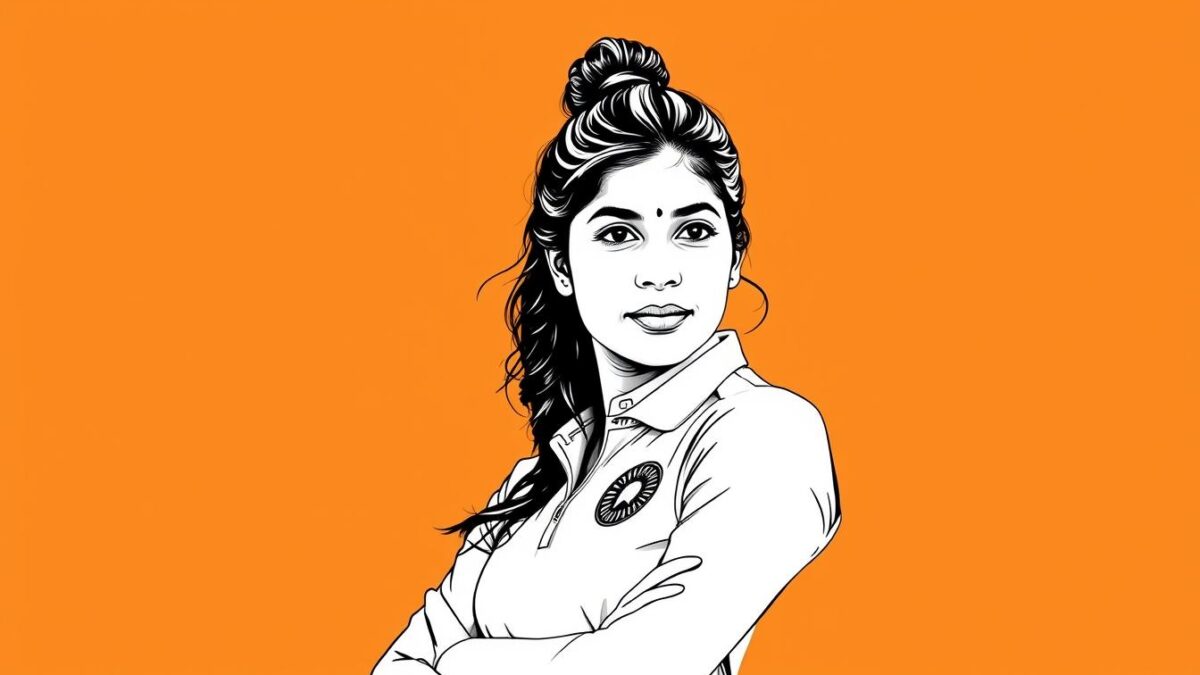
She arrived on the scene from Jodhpur, a right-handed batter with a quiet intensity. Her career in cricket began over two decades ago, a journey that would redefine the sport for women in India.
This legendary player captained the national side for 18 years. She led the team to two ICC ODI World Cup finals, a feat no other woman has matched. Her leadership spanned a crucial era of growth for the game.
Retiring in 2022, she left as the highest run-scorer in women’s international cricket. Her record of over 10,000 runs stands as a towering achievement. She set a standard for consistency and grace under pressure.
Her impact extends beyond numbers. She became a symbol of perseverance, inspiring a generation of athletes. The professionalization of women’s cricket in India carries her imprint, a legacy built on pure skill and determination.
Introduction to the Cricket Icon
The numbers tell only part of the story of this cricket pioneer who carried the hopes of a nation while rewriting record books. Her career spanned the transformation of women’s cricket from amateur pursuit to professional sport.
She became the highest run-scorer in women’s international cricket, a testament to two decades of consistency. In 2017, Wisden recognized her as the Leading Woman Cricketer in the World. This honor highlighted her technical skill and mental resilience.
Her record-setting seven consecutive ODI half-centuries demonstrated remarkable reliability during pressure situations. This achievement showcased her ability to perform when tournaments mattered most. She also holds the record for most half-centuries in Women’s ODIs.
| Format | Matches | Runs | Average | Notable Achievement |
|---|---|---|---|---|
| ODI | 232 | 7,805 | 50.68 | First woman to 200 ODIs |
| Test | 12 | 699 | 43.68 | Highest score: 214 |
| T20I | 89 | 2,364 | 37.52 | 67 half-centuries total |
| International | 333 | 10,868 | 46.56 | All-time leading scorer |
Reaching 200 ODI matches in 2019 underscored her longevity and dedication. This milestone reflected her enduring impact on the game. She played through multiple eras of women’s cricket evolution.
In July 2021, she surpassed Charlotte Edwards’ record of 10,273 international runs. This final achievement cemented her place as the most prolific run-scorer across all formats. Her career trajectory mirrored the growth of women’s cricket itself.
Early Life and Inspirations
Her journey began not with ambition but with reluctant early mornings accompanying her brother to practice. The discipline came naturally from her father’s Air Force background, where structure defined daily life.
Family Background and Childhood
Born in Jodhpur to a Tamil-speaking family, she moved to Hyderabad during her formative years. Her father served as a warrant officer, instilling military precision in their household routine.
She initially showed more interest in Bharatnatyam dance than sports. At age ten, she started joining her older brother for cricket coaching at six each morning.
The family’s middle-class background meant financial sacrifices for equipment and training. Her father initially dismissed cricket as unsuitable for girls.
The Role of Early Mentorship
A perceptive coach noticed her potential during those early sessions. After watching her hit tennis balls, he made a life-changing recommendation to her father.
“Invest in your daughter,” the coach advised. “She might play for India one day.” This endorsement shifted the family’s focus entirely.
Schools like Keyes High School supported her cricket ambitions by accommodating her training schedule. Within a year, she progressed from school-level matches to state teams.
Domestic Cricket Journey
Long before the international spotlight, her career was built on the foundations of local leagues and state teams. This period shaped her technique and temperament.
It provided the essential groundwork for a legendary international career.
Starting Out with Local Teams
Mithali Raj began with Air India. She shared a dressing room with seasoned players like Purnima Rau.
This experienced cricket team environment taught her the professional demands of the sport. Learning from veterans like Purnima Rau accelerated her growth.
She represented her state at under-16 and under-19 levels remarkably early. This fast-tracked her development against older competition.
Transition from School to Pro-Level Cricket
Her move from school games to professional leagues was rapid. Talent and early newspaper recognition fueled her motivation.
She later joined Indian Railways, a cornerstone for women cricket in India. For many years, it offered one of the few stable jobs for female players.
This provided financial security and a platform to hone her skills in the national championship. Railways was vital for her cricket career.
In the Women’s T20 Challenge, Mithali Raj played for teams like Supernovas and Velocity. These leagues boosted the profile of domestic women cricket.
Her consistent domestic performances were the final proof needed for an international call-up.
International Debut and Breakthrough
A World Cup snub at fourteen only sharpened her focus. This near-miss fueled a determination that led to a historic start in international cricket.
First Steps in ODIs and Test Matches
Her One Day International debut came in 1999 against Ireland. At just sixteen, she scored an unbeaten 114 runs. This century announced her readiness for the highest level of the game.
The Test debut followed in the 2001-02 season against South Africa. She adapted quickly to the longer format’s demands. This early success in both formats solidified her place in the team.
Key Moments in Early International Career
A defining moment arrived in her third Test match. On August 17, 2002, she faced England women. At nineteen, she shattered the world record for the highest individual Test score.
Her innings of 214 runs showcased key traits that defined her entire career:
- Technical mastery against a skilled bowling attack.
- Exceptional concentration to bat across multiple sessions.
- The ability to build an innings under pressure.
This record-breaking performance, though later surpassed, established Mithali Raj as a cornerstone of Indian women’s cricket. It earned immediate respect from opponents and cemented her legacy early.
Records, Achievements, and Milestones
Statistical milestones became familiar territory throughout her remarkable international journey. Her career reads like a catalog of firsts and record-breaking performances.
Historic Run-Scoring Feats
She stands alone as the only female cricketer to surpass 7,000 runs in Women’s ODIs. Her consistency spanned over two decades of international cricket.
The 2017 Women’s Cricket World Cup showcased her remarkable form. She scored seven consecutive half-centuries, a record unmatched by any player.
| Record Category | Achievement | Year | Significance |
|---|---|---|---|
| ODI Runs | First to 7,000 runs | 2017 | Only female cricketer |
| Consecutive 50s | Seven in row | 2017 | World Cup record |
| T20I Runs | 2,000 runs milestone | 2018 | First Indian cricketer |
| ODI Appearances | 200 matches | 2019 | First woman |
| Total Runs | 10,273+ runs | 2021 | Surpassed Charlotte Edwards |
Notable World Cup and Asia Cup Performances
Her 2018 Women’s Twenty20 Asia Cup performance made history. She became the first Indian cricketer to score 2,000 T20I runs.
World Cup tournaments saw her excel consistently. She joined the elite group of players with over 1,000 World Cup runs.
Leading India to two World Cup finals defined her legacy. The 2005 tournament in South Africa and 2017 in England showcased her leadership.
Mithali Raj – A Cricketing Legend
The “Lady Tendulkar” nickname captured more than just batting statistics—it reflected a career built on technical mastery and quiet authority. This player commanded respect through two decades of consistent performance in women’s cricket.
In 2019, she became the first woman to complete twenty years in international cricket. Her career spanned multiple generations of players, from senior teammates to athletes not yet born when she first wore the India jersey.
She evolved from teenage prodigy to seasoned captain and mentor. Her influence extended beyond statistics, becoming a symbol of resilience for women cricketers facing limited opportunities in earlier years.
Mithali Raj’s ability to reinvent her game and adapt to changing team dynamics set her apart. She remained relevant in a fast-evolving sport, leaving a legacy that transcends runs and records.
Leadership and Captaincy Evolution
Her captaincy began not with a seasoned strategy, but with the immense pressure of a World Cup. At twenty-two, Mithali Raj was named permanent captain just before the 2005 tournament in South Africa. She led the India women’s team to the finals in her first major assignment.
This started a seventeen-year leadership career. She is the only female player to captain India in multiple ICC ODI World Cup finals, repeating the feat in 2017.
Initial Challenges and Early Captaincy
Early on, she equated leadership with control and authority. This approach was shaped by her youth and the high-stakes environment. A three-year period away from the captaincy proved transformative.
It allowed her to interact with teammates differently. She gained a deeper understanding of what players needed from their leader.
Growth into a Respected Leader
When she regained the captaincy in 2012, her philosophy had evolved. She prioritized communication and empathy over rigid command. Her concept of leadership matured through distinct phases.
- Initially, it was about strategy and organization.
- Later, it shifted towards compassion and collaboration.
- She learned to value teammate trust over external validation.
The transition of women’s cricket to the Board of Control for Cricket in India brought better support. This helped professionalize the sport during her tenure. She skillfully managed players from different generations, adapting her style to bridge experience gaps.
Coaching and Mentorship Contributions
Transitioning from player to mentor, her expertise became a vital resource for the next generation. This phase allowed Mithali Raj to directly shape the future of Indian women cricket.
Her knowledge gained over 23 years found new purpose in development roles. She focused on building sustainable talent pipelines for the national program.
Role as a Batting Consultant
As batting consultant for the national cricket team, she emphasized mental approach alongside technique. Younger players received guidance on handling pressure situations.
She shared insights about building innings across different formats. Her experience with shot selection became invaluable training material.
Experiences as a Player-Coach
The player-coach role let her mentor teammates during actual competition. This provided real-time feedback that practice sessions couldn’t match.
She demonstrated leadership through example rather than instruction. Her dual role helped bridge experience gaps within the squad.
| Coaching Role | Primary Focus | Key Contribution | Beneficiaries |
|---|---|---|---|
| Batting Consultant | Technical refinement | Mental resilience training | National team batters |
| Player-Coach | In-game strategy | Real-time adjustment guidance | Teammates during matches |
| Mentor | Career development | Transition support | Emerging cricketers |
Her approach as a coach extended beyond technical skills. She emphasized the importance of consistency and professional mindset.
This mentorship created a stronger foundation for the women’s cricket ecosystem. The impact continues through players she directly influenced.
Controversies and Challenges on the Field
The 2018 ICC Women’s World Twenty20 brought unexpected challenges that tested team dynamics and leadership. This tournament revealed the complex pressures facing senior players in modern cricket.
Management Disputes and Team Dynamics
A semifinal exclusion sparked major controversy. The captain was dropped from the crucial match against England, creating internal conflict.
Mithali Raj wrote to the BCCI alleging bias from coach Ramesh Powar. She claimed her exclusion lacked cricketing merit. Powar countered with serious allegations about team conduct.
He accused the senior player of prioritizing personal milestones over team strategy. The coach criticized a particular innings where 25 dot balls stalled momentum.
| Event | Key Parties | Main Allegations | Outcome |
|---|---|---|---|
| Semifinal Exclusion | Mithali Raj, Coach Powar | Bias claims vs team strategy concerns | Public controversy |
| BCCI Letter | Raj, Powar, Diana Edulji | Humiliation allegations | Internal investigation |
| Media Response | Both parties | Conflicting statements | Public scrutiny |
| 2021 Reconciliation | Raj, Powar, Harmanpreet Kaur | Mutual respect emphasized | Conflict resolution |
Handling Media and Public Criticism
The public dispute exposed tensions within the women’s cricket team. Media scrutiny intensified around leadership roles and batting positions.
Reports suggested strained relationships between senior players. Every decision faced intense examination from fans and critics alike.
This World Cup episode highlighted the difficulties of managing team dynamics. Senior players often face tough transitions in fast-paced formats.
By 2021, reconciliation occurred when Powar returned as head coach. Both Mithali Raj and Harmanpreet Kaur confirmed mutual respect remained. The focus returned to the game itself.
Awards and Recognitions
From national honors to international acclaim, the trophy case tells a story of consistent excellence and groundbreaking impact. The cricketer’s awards span two decades, reflecting both personal achievement and the growing recognition of women’s cricket.
National Honors and Civil Awards
Her first major honor came in 2003 with the Arjuna Award. This recognized her early impact on the sport. The Padma Shri followed in 2015, acknowledging her role as a trailblazer.
In 2021, she received India’s highest sporting honor. The Major Dhyan Chand Khel Ratna Award capped her career. It celebrated sustained excellence over twenty years.
International Accolades and Records
The year 2017 brought multiple global recognitions. She was named Wisden Leading Woman Cricketer in the World. This followed her impressive World Cup performance.
That same year, she joined the ICC Women’s ODI Team. Ellyse Perry also received honors that year. Both players dominated the women world of cricket.
In 2020, she was nominated for ICC Female Cricketer of the Decade. Ellyse Perry ultimately won the award. The nomination itself highlighted her lasting influence.
| Year | Award | Category | Significance |
|---|---|---|---|
| 2003 | Arjuna Award | National Sports | Second highest sporting honor |
| 2015 | Padma Shri | Civilian | Fourth highest civilian award |
| 2017 | Wisden Recognition | International Cricket | Leading Woman Cricketer |
| 2021 | Khel Ratna | National Sports | Highest sporting honor |
Impact Beyond the Cricket Field
The discipline of classical dance, not just cricket, shaped the rhythm and grace of her legendary career. Her training in Bharatanatyam instilled a focus that translated directly to her batting technique.
This artistic side added depth to her public persona, making her story compelling beyond sports.
Cultural Influence and Media Presence
Following the 2017 World Cup, her influence reached new heights. Viacom 18 Motion Pictures acquired the rights to a biopic about her life.
She hoped the film would inspire young girls to see sports as a viable career. It was a conscious effort to change perceptions about women in athletics.
Her media presence consistently advocated for gender equality. She pushed for better pay and opportunities for women cricketers, challenging a system that historically favored men.
Biopic and Popular Culture References
The film, titled “Shabaash Mithu,” faced production delays, including a director change. Taapsee Pannu was ultimately cast in the lead role.
Released in July 2022, the biopic unfortunately underperformed commercially. It earned a fraction of its budget, a financial disappointment for a story of such significance.
Despite this, the project cemented her status as a cultural icon. Her journey resonated as a reflection of the broader struggles and triumphs for women in India.
Insights from Personal Interviews and Leadership Stories
The making of a cricket icon started with a lazy child who preferred dance over sports and sleep over practice. In a revealing interview, Mithali Raj shared how her father’s military background imposed discipline that shaped her entire life.
Her brother’s coach saw potential where others saw reluctance. After watching her hit tennis balls, he told her father to invest in her training. This moment gave her a chance at a career she never imagined.
Lessons in Resilience and Personal Growth
Leaving home at ten for tours forced early independence. The women cricket scene offered little recognition or money during those years. She questioned why she played when rewards were scarce.
Her career split into two distinct eras. Before the Board of Control for Cricket in India took over, international series were rare. Sometimes two years passed without a World Cup or match against teams like New Zealand.
Leading four generations of players taught her adaptability. She learned that leadership isn’t about seeking validation but earning team trust. This evolution defined her second captaincy chance.
Mithali Raj’s journey shows how resilience transforms reluctant beginnings into legendary careers. Her story offers a roadmap for any player facing long odds in sports or life.
Final Reflections on a Storied Career
Retirement arrived not as a single moment, but as a series of deliberate steps that closed a monumental career. In 2019, Mithali Raj retired from T20Is to focus entirely on the ODI World Cup. This strategic move highlighted her deep understanding of her game and goals.
Her leadership remained vital in her final years. She captained the Test side against England in 2021 and led India at the 2022 Women’s Cricket World Cup. That final tournament was her seventh World Cup appearance, a record of longevity.
Her retirement announcement in June 2022 ended a 23-year journey. She left as the all-time leading run-scorer in women’s international cricket. Her records in ODIs and Tests may stand for decades.
More than statistics, her career mirrored the rise of women’s cricket itself. She helped transform it from a niche pursuit into a professional sport. Young girls in India now see a path forward, a legacy built on pure skill and determination.