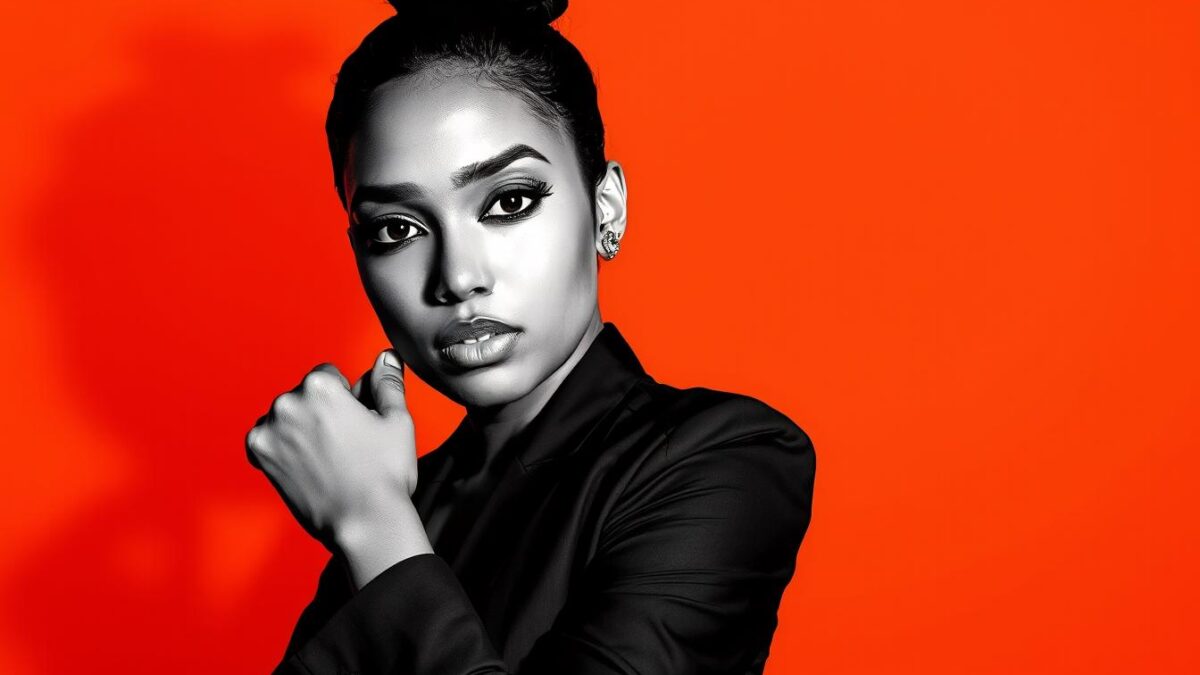
Mathangi “Maya” Arulpragasam arrived in the world on a July day in 1975. Born in London to parents of Sri Lankan Tamil descent, her early life shaped a unique artistic vision.
She chose a stage name with a double meaning. M.I.A. stands for “Missing in Action” and “Missing in Acton.” This link between personal history and global conflict defines her work.
Her sound is a powerful fusion. She blends dance, electronic, and hip hop with world music influences. This creates a singular style that defies easy labels.
Beyond her music, she is a committed activist. Her art carries a political and cultural urgency. It speaks to themes of displacement and belonging.
Her impact is recognized by major institutions. She received an MBE honor for her services to music. She also made history with simultaneous Oscar and Grammy nominations.
Early Beginnings and Cultural Roots
Her childhood was shaped by the turbulence of the Sri Lankan Civil War from infancy. At six months old, her family moved from London to Jaffna in northern Sri Lanka.
Childhood in Sri Lanka and London
The first eleven years were marked by constant displacement. Her family hid from the Sri Lankan Army during the war.
They moved between Jaffna and Madras for safety. At age eleven, they returned to London as refugees.
She spent her remaining childhood on the Phipps Bridge Estate in Mitcham. This was one of only two Asian families in the area.
Family Inspirations and Cultural Heritage
Her father adopted the name Arular and became a political activist. He was a founding member of EROS, affiliated with the LTTE.
For safety, he was introduced to the children as their “uncle.” Her mother worked as a seamstress for the Royal Family.
This contrast between militant activism and skilled craft defined her upbringing. Both influences would later shape her artistic voice.
| Location | Time Period | Key Experience |
|---|---|---|
| Jaffna, Sri Lanka | 6 months – 11 years | Civil war displacement |
| Madras, India | Early childhood | Temporary safety refuge |
| London, UK | Age 11+ | Refugee resettlement |
Visual Artistry and Film: The Formative Years
Her artistic journey began not with music, but with a paintbrush and a camera. She built her foundation in visual expression before sound entered the picture.
Central Saint Martins College became her creative laboratory. She entered through unconventional means, graduating in 2000 with a degree in fine art, film, and video.
Transition from Visual Art to Moving Images
Radical cinema shaped her approach. She drew inspiration from Harmony Korine and Spike Jonze. Their work showed her how to make realism accessible.
She put theory into practice with Elastica. The band’s frontwoman commissioned album art and tour documentation. This introduced her to music industry tools.
In 2001, she attempted a documentary about Tamil youth. The project faced harassment in Jaffna and remained unfinished. But the drive to use images as testimony persisted.
That same year, her first public exhibition fused Tamil political graffiti with London consumerism. The show earned an Alternative Turner Prize nomination. Actor Jude Law purchased several pieces.
| Year | Project | Artistic Significance |
|---|---|---|
| 1999 | Meets Elastica through Damon Albarn | First music industry connection |
| 2000 | Graduates Central Saint Martins | Formal training in film and video |
| 2001 | Portobello Road exhibition | Establishes visual artist reputation |
| 2001 | Jaffna documentary attempt | Early political film project |
This period built the skills she would later combine. She learned to mix politics with pop culture. These foundations made her music videos as crucial as her songs.
Musical Genesis and Underground Breakthrough
Her musical journey ignited not in a professional studio, but through the thin walls of a London housing estate. In the late 1980s, radio broadcasts from neighboring flats became her first education in sound.
She connected deeply with the starkness of hip-hop and dancehall. Records by Public Enemy and Ultramagnetic MCs carried an urgency that resonated with her own experiences.
Early Experiments with Sound and Beats
College expanded her palette to include punk, Britpop, and electroclash. Bands like The Slits and The Clash showed her how rebellion could sound.
A pivotal moment came from electroclash artist Peaches. She handed the aspiring artist a Roland MC-505 groovebox with a simple instruction: make music.
This encouragement sparked a transformation. While on holiday in Bequia, she began experimenting with the machine in a chicken shed. There, she learned rhythm by dancing first.
Returning to West London, she built a makeshift studio. Using a secondhand 4-track tape machine and the MC-505, she crafted a six-song demo.
This collection of early songs included raw versions of “Galang” and “Lady Killa.” These tracks captured a unique fusion of dance music and global influences. They would soon become her first underground singles.
That year marked the true beginning of her sound. It was born from limitation, curiosity, and a borrowed machine.
The Evolution of MIA Arulpragasam: From Underground to Mainstream
Before the beats and the bold visuals, there was the name. A moniker born from personal loss and geographic identity.
Adopting the Iconic Stage Name
The artist’s stage name carries a powerful double meaning. M.I.A. stands for “Missing in Action” and “Missing in Acton.”
This choice was deeply personal. It came from her search for a cousin who disappeared during the Sri Lankan conflict.
She was living in Acton, West London, at the time. The name merged her immediate surroundings with a distant tragedy.
“Missing in Action” is a military term. It directly references the war that displaced her family and many Tamil people.
Her birth name, Mathangi, was often mispronounced by classmates. Her aunt suggested the simpler nickname “Maya,” which stuck.
This new artist name turned absence into a powerful presence. It signaled what was lost while firmly asserting what remained.
The complexity of the name foreshadowed her work. It would be political, personal, and impossible to simplify.
Arular – Breaking Through with Bold, Experimental Sounds
The year 2005 marked a seismic shift in music with the arrival of a debut album recorded in a West London bedroom. Titled Arular, this release bypassed traditional industry paths, building on file-sharing buzz and early MySpace uploads.
This debut album’s title held deep personal meaning. It honored her father’s revolutionary nom de guerre, embedding Tamil resistance directly into the project’s core.
Integrating Political Themes in Music
The album’s sound was a jarring, brilliant fusion. Tracks blended dancehall, electro, and jungle with lyrics about guerrilla warfare and asylum seeking.
Songs like “Sunshowers” delivered politics through rhythm, not sermon. The music felt urgent and globally aware.
“Bucky Done Gun” broke new ground. It became the first funk carioca-inspired song played on mainstream Brazilian radio.
| Single | Release Year | Musical Innovation |
|---|---|---|
| Galang | 2003/2004 | Underground file-sharing hit |
| Sunshowers | 2004 | Lyrics on conflict and displacement |
| Bucky Done Gun | 2005 | Pioneered Brazilian funk on radio |
Critics embraced the album’s bold vision. Arular earned a Metacritic score of 88, signaling universal acclaim.
It was named the seventh best-reviewed album of 2005. This bedroom project had reshaped the sound of dance music.
Kala – A Fusion of World Music, Dance, and Politics
The album ‘Kala’ emerged from a passport stamped across six continents, each location leaving its sonic fingerprint. Visa complications forced a nomadic recording process that became the project’s greatest strength.
Cultural Narratives and Socio-Political Commentary
This second studio album layered soca, gaana’s urumee drums, and Tamil film bootlegs into a dense mix. The songs balanced celebration with raw themes of immigration and war.
“Jimmy” addressed an invitation to tour genocide-affected Rwanda. The track embedded human rights commentary into vibrant dance music.
| Single | Release Month | Chart Position | Thematic Focus |
|---|---|---|---|
| Bird Flu | February 2007 | MySpace Release | Global health concerns |
| Boyz | June 2007 | Top 10 Hit | Dance celebration |
| Jimmy | August 2007 | Critical Acclaim | Human rights advocacy |
Achieving Global Recognition
Kala’s 2007 release earned universal acclaim with an 87 Metacritic score. Rolling Stone and Blender named it the best album of the year.
The project proved that world music and political dance could achieve commercial success. It became the tenth Best-Reviewed Electronic/Dance Album of the decade.
Global Impact of “Paper Planes”
A single track can define an artist’s career, and for this musician, that track was “Paper Planes.” Released digitally in February 2008, the song was a sharp satire on immigrant stereotypes. It cleverly used gunshot sounds and cash register noises over a Clash sample.
The song’s success was immediate and massive. It became a cultural phenomenon, reaching far beyond its initial audience.
Chart-Topping Success and Critical Acclaim
“Paper Planes” climbed to number four on the US Billboard Hot 100 chart. Its popularity exploded after featuring in the trailer for the film Pineapple Express. This introduced the artist’s unique sound to a huge mainstream American audience.
The track’s commercial performance was staggering. It sold over 3.6 million copies in the United States alone. This achievement earned it triple platinum certification.
| Achievement | Detail | Significance |
|---|---|---|
| Billboard Peak | No. 4 on Hot 100 | Mainstream chart breakthrough |
| US Sales | 3.6 million copies | Triple platinum certification |
| Grammy Nomination | Record of the Year | Highest industry acclaim |
| Label Sales Record | XL Recordings’ 2nd best-seller | Major commercial impact |
The song’s impact was cemented with a Grammy Award nomination for Record of the Year. This honor recognized the track’s exceptional quality and cultural resonance. Co-produced with Diplo, the record proved that politically charged music could achieve the highest levels of success.
Diversifying the Musical Palette: Maya and Beyond
Following the global success of “Paper Planes,” the artist’s third album marked a deliberate turn toward darker, more confrontational themes. Recorded in a Los Angeles home studio, the project embraced the chaotic energy of the internet.
Experimentation with New Genres and Visuals
The album cycle began with a shock. The “Born Free” video leaked online in April 2010. Directed by Romain Gavras, this short film depicted a brutal genocide against red-haired youth.
Its graphic content sparked immediate controversy. YouTube removed and reinstated the video multiple times. This bold visual statement set the tone for the entire album.
When the album arrived in June 2010, it incorporated industrial music for the first time. The artist described the sound as a mix of “babies, death, destruction and powerlessness.”
| Track | Type | Chart Performance | Musical Style |
|---|---|---|---|
| XXXO | Official Single | Top 40 in UK, Belgium, Spain | Electropop |
| Born Free | Promotional Video | Charted in Sweden, UK | Industrial Punk |
| Teqkilla | Promotional Single | Top 100 in Canada | Experimental Dance |
This third album became her highest-charting release globally. It debuted in the top ten in the US, Canada, and several European countries.
Critics delivered divided reviews. Some praised the fearless experimentation. Others found the new sound challenging. The artist refused to soften her message, pushing boundaries in both music and visuals.
Matangi and AIM: Reinventing the Sound
Her fourth studio album arrived in 2013, marking a powerful return. The project spawned the single “Bad Girls,” a track that quickly won MTV Video Music Awards.
The “Bad Girls” video became an instant classic. It drew inspiration from YouTube car stunts and photographs of an Arab female trucker.
This visual work challenged Western stereotypes with high-octane energy. The artist described it as her second favorite music video.
Her fifth album, AIM, saw a 2016 release. It was preceded by “Poc Still A Ryda,” a lyrical mix of the album’s songs.
Reviews were mixed, but the music refused to repeat past successes. A new song, “P.O.W.A,” emerged from the AIM sessions in 2017.
| Project | Year | Key Track | Visual Focus |
|---|---|---|---|
| Matangi | 2013 | Bad Girls | Middle Eastern car culture |
| AIM | 2016 | Borders | Global refugee crisis |
| Matahdatah Scroll | 2015 | Warrior / Swords | Dance forms in India & West Africa |
The 2015 video “Matahdatah Scroll 01 Broader Than a Border” showcased regional dances. Filmed in India and West Africa, it sampled Yo Yo Honey Singh.
Later that year, “Borders” mocked first-world problems. Its self-directed video placed her among migrants on boats and barbed-wire fences.
This period reinforced her commitment to global themes. Each release used sound and image to confront urgent issues.
Award-Winning Achievements and Industry Milestones
Her groundbreaking year saw simultaneous nominations at both the Grammys and Oscars. This dual recognition marked a historic moment in entertainment.
Celebrating Grammy and Academy Recognition
In 2009, she earned an Academy Award nomination for “O…Saya.” This collaboration with A.R. Rahman appeared on the Slumdog Millionaire soundtrack.
Her single “Paper Planes” received a surprise Grammy Award nomination. The track competed for Record of the Year honors.
Her Grammy Awards performance became instantly memorable. Nine months pregnant, she shared the stage with T.I., Jay-Z, and Kanye West.
She made history as the first South Asian artist nominated for both awards in the same year. This achievement broke new ground for representation.
The artist’s Super Bowl XLVI halftime show sparked controversy. Her middle finger gesture during the performance led to an NFL lawsuit.
She responded with the diss track “Boom ADD.” The song directly addressed the league’s legal action.
Time magazine named her one of 2009’s most influential people. Esquire included her among the 21st century’s top influencers.
Additional honors included BRIT Award nominations and MTV Video Music Awards. Billboard recognized her as a top dance/electronic artist of the decade.
Cross-Genre Collaborations and Artistic Ventures
Working across genres became a signature of her artistic approach. Early collaborations showed her versatility with different musical styles.
In 2005, she contributed to Missy Elliott’s “Bad Man” on The Cookbook album. This connected her with one of her major influences in hip-hop.
Two years later, her voice appeared on Timbaland’s Shock Value album. The track “Come Around” also featured on her own Kala release.
That same year brought a notable remix of “Boyz” featuring Jay-Z. This collaboration bridged her underground origins with mainstream rap success.
Her 2008 work included “Sound of Kuduro” with Buraka Som Sistema. They recorded the track in Angola with an energetic accompanying video.
She also filmed a documentary with director Spike Jonze that year. The project featured Nigerian immigrant rapper Afrikan Boy in South London.
Pop collaborations continued with Christina Aguilera’s 2010 album Bionic. M.I.A. helped write the song “Elastic Love” for the project.
Electronic music found her performing on SebastiAn’s “C.T.F.O.” This mix of styles showed her range across different music scenes.
In 2020, she appeared on Travis Scott’s “Franchise” alongside Young Thug. The single reached number one on the Billboard Hot 100 chart.
These ventures mapped her artistic journey across two decades. She built bridges between pop, politics, and global music traditions.
Activism and Social Commentary in Her Work
For this artist, the dance floor was never just a place for escape. It was a platform for testimony. Her work consistently merges infectious rhythms with urgent political and social commentary.
Music as a Platform for Change
The Sri Lankan Civil War provided a defining context for her artistry. This personal history of conflict and displacement echoes throughout her songs.
Tracks like “Sunshowers” use dancehall beats to carry lyrics about guerrilla warfare and asylum seeking. The music makes complex themes accessible to a global audience.
Her support for humanitarian aid in Sri Lanka sparked debate. Critics sometimes misinterpreted her focus on civilian suffering as political endorsement.
The song “Borders” directly tackles the refugee crisis. Its powerful video mocks first-world problems by placing the artist among migrants.
She uses pop music to discuss the Iraq War, genocide, and immigration politics. Her art ensures clubs become spaces for awareness.
M.I.A. turns songs into witness statements. She amplifies voices and issues that the wider world often ignores.
Influence on Global Music, Media, and Culture
The internet era found one of its first musical pioneers in an artist who bypassed traditional gatekeepers entirely. From 2002, she uploaded her songs and videos directly to platforms like MySpace.
This built a large, global fanbase through digital channels alone. She became a case study for how the internet reshapes music discovery.
Her impact was recognized by major institutions. Rolling Stone named her a defining artist of the 2000s.
Time magazine listed her among the world’s 100 most influential people in 2009. Esquire also included her on its 21st-century influencers list.
Her distinctive style blended world music, hip-hop, and electronic dance. Lyrics carried political, social, and philosophical weight.
This approach influenced a generation of artists. They saw music as both art and activism.
Billboard ranked her a top dance/electronic artist of the 2010s. This acknowledged her sustained relevance.
| Publication | Year | Recognition | Significance |
|---|---|---|---|
| Rolling Stone | 2000s Decade | Defining Artist | Musical impact of the era |
| Time | 2009 | Top 100 Influential People | Global cultural influence |
| Esquire | 21st Century | Top 75 Influencers | Enduring legacy |
| Billboard | 2010s | Top 50 Dance/Electronic Artist | Genre-shaping contribution |
She changed not just what artists sound like. She reshaped how they distribute their work and engage with the world.
Exploring Multimedia and Innovative Presentations
Her creative vision always extended far beyond the audio track. The artist treated the visual component as an equal partner to the sound. This multimedia approach made every video a complete artistic statement.
Music Videos, Design, and Visual Expression
From 2000 to 2010, she directed numerous videos. She helmed clips for songs like “Bird Flu,” “Boyz,” and “XXXO.” This hands-on work ensured her political and aesthetic vision remained intact.
She also carefully selected directors for other projects. The “Sunshowers” video, shot in South Indian jungles, became her personal favorite. She described it as the perfect adaptation of her song’s themes.
The “Bad Girls” video drew inspiration from online car stunts and photographs of an Arab female trucker. It celebrated women’s defiance and Middle Eastern car culture. This visual work became her second favorite.
Her commitment to visual art was foundational. In 2001, she received an Alternative Turner Prize nomination. Her Portobello Road exhibition mixed Tamil political graffiti with London consumerism.
She founded the multimedia label N.E.E.T. Recordings. It promoted artists whose work blended sound and image. This venture solidified her role as a holistic creative force.
Impact of the Digital Age on M.I.A.’s Career
When most artists were still chasing record deals, she was building a global audience from her computer. The internet became her primary stage long before digital distribution became industry standard.
Leveraging the Internet for Global Reach
From 2002 onward, M.I.A. uploaded songs and videos to MySpace. This was years before social media marketing became common practice. File sharing and college radio created an underground buzz without traditional label support.
Tracks like “Galang” and “Sunshowers” spread through dance clubs and fashion shows. They reached people worldwide through digital networks. The artist built a large fanbase exclusively through these channels.
In June 2004, she began uploading music to her MySpace account. By February 2007, she posted “Bird Flu” with its accompanying music video. This demonstrated how artists could control their own release schedule.
Her early compositions relied on the Roland MC-505 music sequencer. Later work incorporated rare instruments and unusual sound samples. She evolved with technology rather than being limited by it.
This digital approach redefined music distribution for a new generation. It proved the world was ready for an artist who bypassed traditional gatekeepers.
Final Reflections on a Trailblazing Journey
Decades into a trailblazing career, the artist’s journey remains a testament to innovation and defiance. Her sixth studio album, Mata, released in 2022, confirmed a refusal to retire or repeat past successes.
The 2019 MBE honor for services to music created an ironic full circle. It was official recognition from an establishment she often critiqued. This marked a profound moment for the Sri Lankan-British artist.
Major publications cemented her influence. Rolling Stone named her a defining voice of the 2000s. Time magazine listed her among the world‘s most influential people of that time.
M.I.A. broke barriers as the first South Asian person nominated for an Oscar and Grammy in the same year. Her legacy reshapes what music and activism can achieve together.