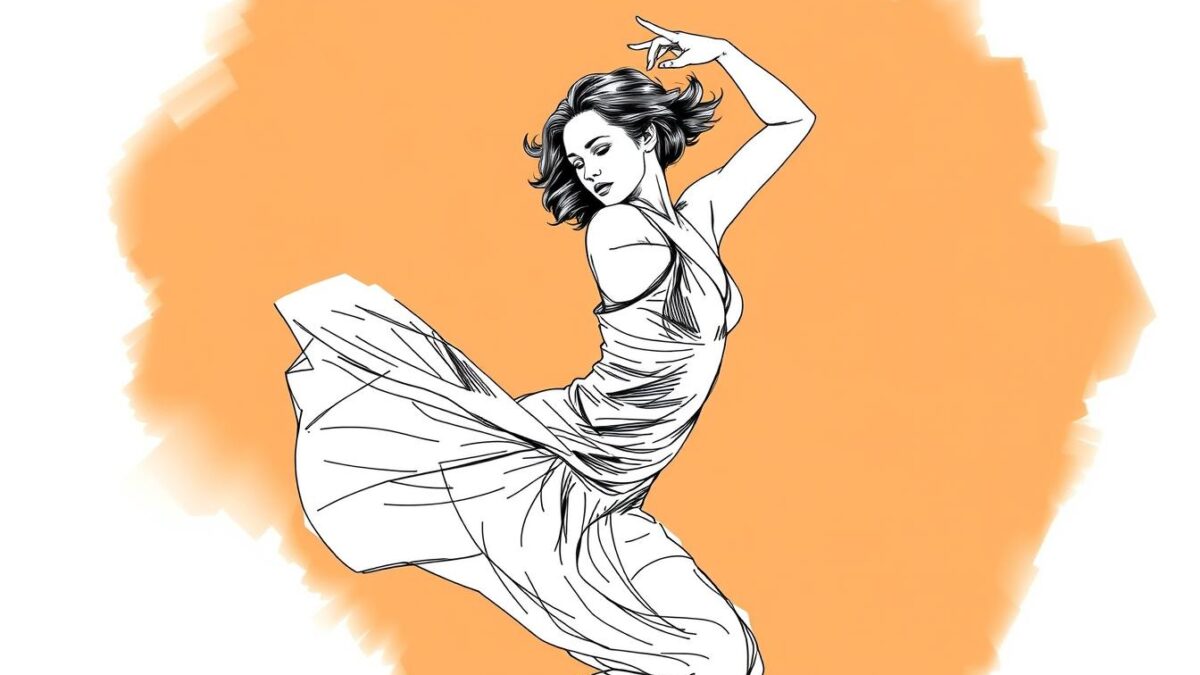
Some artists build a reputation on spectacle. This one earned hers through raw, uncompromising work. From the start, her movement vocabulary refused to follow tradition.
Her 1978 debut, *Crystallization*, announced a powerful new voice. The performance was driven by authentic communication and a fearless physicality. It challenged audiences with intimate rituals.
For twelve years, she worked as a solo performer and choreographer. She created thirty solo works seen across the globe. This period cemented her status as Canada’s “enfant terrible.”
In 1990, she founded her own company, shifting from soloist to artistic director. Her influence now extends far beyond choreography. She also works as a writer, set designer, and filmmaker.
Her impact is confirmed by rare honors. She was appointed an Officer of the Order of Canada. Her name appears in major French dictionaries, a testament to her lasting cultural mark.
Early Beginnings: Establishing a Revolutionary Dance Presence
A career built on radical honesty began with a 1978 collaboration that signaled a new direction in performance art. Marie Chouinard’s first work, Crystallization, created with artist Rober Racine, established her commitment to visceral physical expression.
First Solo Performances and Early Works
Between 1978 and 1990, she created thirty solo pieces that challenged conventional dance. The 1982 work marie chien noir became notorious for its intimate rituals and controversial masturbation scene.
This piece featured soft guttural sounds that accompanied ritualistic movements. Collaborator Rober Racine described it as “a world of pure participation.”
Influential Collaborations and Formative Experiences
Early performances like Mimas, Lune de Saturne and S.T.A.B. blended dance with video and vocal experimentation. Her 1987 piece L’Après-midi d’un faune used synthesizer controls attached to her body.
Recognition came with the Jacqueline Lemieux Prize in 1986 and Jean A. Chalmers Award in 1987. These years established a philosophy where the body spoke truths words could not express.
Marie Chouinard: Innovator in Contemporary Dance
A pivotal vision in 1990 transformed a singular artistic path into a collective force. While rehearsing a new solo, an image of many dancers appeared, compelling the founder to establish her own ensemble.
Transition from Solo Artist to Company Founder
This shift marked the birth of Compagnie Marie Chouinard. The company quickly became a global touring presence.
In 2007, it secured a permanent creative base, Espace Marie Chouinard, in Montreal. This gave the company a stable home for its distinct work.
Award-Winning Choreography and Iconic Performances
Major works from this period gained immediate and lasting recognition. Le Sacre du printemps (The Rite of Spring), premiered in 1993, remained in the repertoire for over twenty years.
This powerful piece earned the Boat Award in Glasgow in 1994. It confirmed the choreography’s raw impact.
Global Influence and Recognition in the Performing Arts
The company’s reach expanded through partnerships with major international festivals. These included the Biennale di Venezia and the National Arts Centre in Ottawa.
Her works entered the repertoires of other leading companies. The National Ballet of Canada, for instance, performs Les 24 Préludes de Chopin.
This adoption by other troupes spread her unique choreography worldwide. It cemented her status as a defining voice.
Artistic Evolution and Digital Integration in Performance
A natural extension of her choreographic language involved embracing the digital canvas. The founder’s role expanded into set and lighting design, photography, and filmmaking. Each discipline informed the others, creating a rich, multidisciplinary practice.
Exploring Multimedia Installations and Film Projects
Installations like 2004’s Cantique no. 3, created with composer Louis Dufort, transformed performance into an immersive environment. This piece blended sound, space, and movement, inviting direct audience participation.
Film projects allowed Compagnie Marie Chouinard to reach new audiences. The work bODY_rEMIX/gOLDBERG_vARIATIONS was both a live piece and a film. It earned a Gemini Award in 2009 for the dancers’ powerful performance.
Her photo installation, Paradisi Gloria, exhibited at the Montreal Museum of Fine Arts, revealed a sharp visual sensibility. It showed her skill as a designer beyond the stage.
Innovative Techniques and Digital Choreography
Technology became a fundamental part of the choreography itself. The early digital work Cantique: cycle 1 used software for real-time manipulation of sound and video.
In 2015, this exploration led to the CANTIQUE app for iPad and iPhone. It translated artistic concepts into an interactive digital format anyone could experience.
Works like The Golden Mean (LIVE) continued to earn acclaim, winning best choreography awards. This proved her innovative techniques remained vital and recognized.
Final Reflections: Legacy and Future Horizons in Dance
The highest honors in performing arts confirm a career built on fearless physical expression. Marie Chouinard received the Governor General’s Performing Arts Award for Lifetime Achievement in Dance. This recognition from Canada joined a Bessie Award from New York and the title of Chevalier de l’Ordre des Arts et des Lettres from France.
Her influence is cemented in language itself. The choreographer’s name entered major French dictionaries, a rare honor for a living artist. Within Quebec, the Conseil des Arts de Montréal and the Prix du Québec celebrated her profound impact.
After two decades, the dancer returned to solo performance with works that reimagined the performer-audience relationship. She also founded LES PRIX DE LA DANSE DE MONTRÉAL, nurturing the next generation.
The body of works Marie Chouinard created remains a testament to an artist who never compromised. It reshaped contemporary dance for generations.