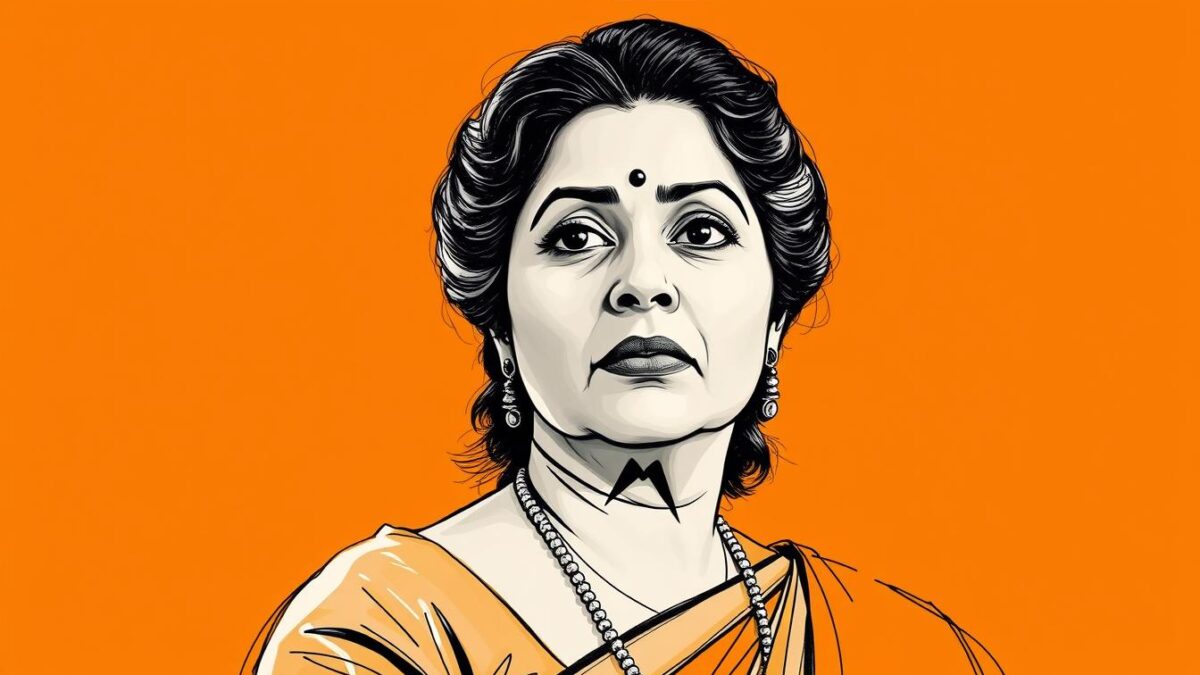
A voice can define a nation’s sound. For India, that voice belonged to Lata Mangeshkar. Her career stretched across eight decades, a testament to her enduring power.
Born in 1929, she rose from modest beginnings to become a true star. Her sharp yet warm soprano transformed playback singing into celebrated art. She gave voice to generations of leading actresses.
Her discipline and precision were legendary. She refused to compromise, shaping the very fabric of Indian music and culture. This is the story of her journey, from childhood training to global recognition.
We explore the woman behind the music. Her challenges, her collaborations, and the legacy she left behind. A story of resilience and unmatched artistic integrity.
Early Life and Musical Roots
Born into a household where melody was the native language, her journey began with classical training at age five. The Mangeshkar home buzzed with artistic energy from dawn until dusk.
Family Background and Early Training
Her father, Deenanath Mangeshkar, was a respected classical singer and theater actor. He instilled rigorous discipline in all five of his children. Lata Mangeshkar absorbed these lessons with remarkable focus.
She was the eldest sibling in a family of gifted musicians. Her sisters Meena, Asha, Usha, and brother Hridaynath would also find success in music. This early environment shaped her entire approach to artistic life.
First Steps in Music and Acting
Tragedy struck when she was just thirteen years old. Her father’s sudden death forced her to support the family. She began acting in small film roles to make ends meet.
Her first recorded song for a Marathi film was cut from the final edit. This early setback only strengthened her resolve. Master Vinayak, a family friend, recognized her talent and became her mentor.
She disliked acting but understood it was necessary at the time. Her true passion remained singing. These early challenges forged the work ethic that would define her career.
| Year | Age | Key Event |
|---|---|---|
| 1929 | Birth | Born Hema Mangeshkar in Indore |
| 1934 | 5 | Began formal music training with father |
| 1942 | 13 | Father’s death; first film recording |
| 1942-1945 | 13-16 | Early acting roles to support family |
Breakthrough in Indian Cinema
Mumbai in the 1940s was a city of dreams, but for a young singer with a unique voice, it presented a wall of resistance. Her high-pitched soprano did not fit the dominant style of the time. Early years were marked by struggle and outright rejection.
Initial Film Roles and Early Challenges
After moving to the city, she focused on her craft. She studied Hindustani classical music to refine her technique. Yet, many film producers were unconvinced.
One famously dismissed her voice as “too thin.” This criticism could have ended her career before it began. Fortunately, a visionary music director saw her potential.
Ghulam Haider became her champion. He gave her the song “Dil Mera Toda” for the 1948 film Majboor. It became her first major hit.
Haider boldly predicted that one day producers would beg her to sing. His prophecy was about to come true.
Transition from Actress to Playback Singer
The defining moment arrived in 1949 with the haunting melody “Aayega Aanewaala” from the film Mahal. Lip-synced by actress Madhubala, the song captivated the nation.
Its popularity was so immense that radio stations revealed the singer’s identity. She transformed into a household name almost overnight.
This success changed everything for playback artists. They shifted from being anonymous technicians to celebrated stars. She fully embraced this role, leaving acting behind to focus on her true passion.
By the decade’s end, she was a rising force in Bollywood. Her early challenges had forged a resilient artist ready for lasting dominance.
The Legacy of Lata Mangeshkar
The measure of an artist’s impact lies in how deeply their work becomes part of a people’s identity. Lata Mangeshkar achieved this rare status, her voice weaving through the emotional landscape of a nation.
Defining the Voice of a Nation
Her career spanned eight remarkable decades, a timeline few artists ever achieve. She recorded songs in over three dozen languages, reaching every corner of the country.
This incredible output earned her the title “Voice of the Millennium.” She gave voice to generations of leading actresses, from classic stars to modern icons.
Her technical precision and emotional depth set a new standard for playback singing. Composers trusted her to capture a character’s deepest feelings.
In 2001, India honored her with the Bharat Ratna, its highest civilian award. This recognized her contribution to the nation’s cultural fabric.
France also awarded her the Legion of Honour for her global influence. Her legacy endures in every singer who follows her path.
Iconic Musical Collaborations
The most enduring musical legacies are built not in isolation, but through dynamic collaborations with visionary creators. Lata Mangeshkar’s career exemplifies this truth.
Her partnerships with India’s greatest composers produced timeless classics. Each director brought out different facets of her remarkable talent.
Working with Legendary Music Directors
Madan Mohan understood her voice like few others. Their work together yielded haunting romantic ballads that still resonate today.
Songs like “Lag Jaa Gale” showcase their perfect synergy. The composer crafted melodies that highlighted her emotional depth.
Her partnership with Laxmikant-Pyarelal spanned thirty-five years. They created over seven hundred songs together.
| Music Director | Collaboration Years | Notable Songs |
|---|---|---|
| Madan Mohan | 1950s-1970s | Lag Jaa Gale, Aap Ki Nazron Ne Samjha |
| Laxmikant-Pyarelal | 1960s-1990s | Mere Naseeb Mein, Sheesha Ho Ya Dil Ho |
| S.D. Burman | 1950s-1970s | Tere Bina Zindagi Se, Aaj Phir Jeene Ki |
| R.D. Burman | 1960s-1980s | Tere Liye, Kuch Na Kaho |
Duets and Creative Partnerships
Her duets with Mohammed Rafi remain legendary. Despite a brief professional disagreement, their artistic chemistry was undeniable.
Collaborations with Kishore Kumar and Mukesh created magic. Each pairing offered unique vocal textures.
Her sister Asha Bhosle also became a celebrated singer. They occasionally blended their distinct styles on special projects.
These creative dialogues pushed Indian film music into new territory. They remain benchmarks for artistic partnership.
Signature Songs and Landmark Performances
Across decades of cinema, a handful of performances transcend entertainment to become national treasures. These signature works defined eras and cemented an artist’s place in cultural history.
Hits that Shaped an Era
The haunting “Aayega Aanewaala” from Mahal (1949) announced a new voice in Indian music. It captured the nation’s imagination overnight.
Her rendition of “Pyar Kiya To Darna Kya” from Mughal-e-Azam became the definitive love song of its time. The emotional depth she brought to each lyric set new standards.
“Lag Jaa Gale” from Woh Kaun Thi? remains one of Hindi cinema’s most romantic songs. Composed by Madan Mohan, it showcased her ability to convey complex emotions.
Memorable Stage and Recording Moments
On January 27, 1963, she performed “Ae Mere Watan Ke Logo” before Prime Minister Jawaharlal Nehru. The patriotic tribute moved the Prime Minister to tears.
This moment transformed her from entertainer to voice of national pride. It remains one of her most celebrated live performances.
In 1974, she became the first Indian playback singer to perform at London’s Royal Albert Hall. Her disciplined stage presence redefined Indian music concerts internationally.
She continued recording hit songs into her seventies, including “Jiya Jale” and “Luka Chuppi.” Each new release proved her enduring relevance across generations.
Influence on Indian Cinema and Culture
Before her arrival, playback singers were often the unseen technicians of Indian cinema. They provided the voice but rarely received the credit. This artist fundamentally reshaped that entire dynamic.
Redefining Playback Singing in Bollywood
She introduced a signature style that moved away from older, more ornate traditions. Her lighter soprano voice offered precise pitch and controlled emotion. It perfectly suited the evolving roles of women in movies.
Music directors began composing specifically for her unique talents. They knew she could deliver clarity and feeling in equal measure. Her career longevity allowed her to adapt to changing trends for decades.
She also fought for better treatment within the industry. She demanded higher fees and even royalty shares. This set a new precedent for fair compensation for all singers.
Some critics argued her dominance limited opportunities for new voices. Yet, her audience remained fiercely loyal. Her influence made playback artists celebrated stars, forever changing the film industry.
Awards, Honors, and Global Recognition
From national ceremonies to international stages, her achievements earned formal acknowledgment across decades. The honors reflect a career that became cultural heritage.
Prestigious National Achievements
In 2001, Lata Mangeshkar received the Bharat Ratna, India’s highest civilian honor. This placed her among the nation’s most celebrated figures.
She had already earned the Padma Bhushan in 1969 and Padma Vibhushan in 1999. The Dadasaheb Phalke Award came in 1989 for lifetime cinema contributions.
The singer won three National Film Awards for playback excellence. After four Filmfare awards, she declined further nominations to support younger talent.
International Accolades and Tributes
France honored her with the Officer of the Legion of Honour in 2009. This recognized her global musical influence beyond her home country.
In 1974, Guinness World Records named her the most recorded artist in history. Her sister later surpassed this remarkable achievement.
She served as a Rajya Sabha member from 1999 to 2005, advocating for artists’ rights. These honors spanned sixty productive years.
Evolution of a Musical Journey Through the Decades
Few artists can claim a creative journey that maps directly onto the evolution of an entire industry. Her career spanned eight decades, adapting to every shift in Indian cinema’s sound.
This timeline shows a constant pursuit of excellence. Each period brought new music and new challenges.
1940s to 1960s: Beginnings and Breaks
The 1940s began with struggle. Rejection was common for her unique voice.
A major break came in 1949 with the hit “Aayega Aanewaala.” This song changed everything.
The 1950s solidified her position. She became the first-choice singer for major music directors.
Hundreds of songs from this time defined the decade’s sound. The 1960s brought legendary classics.
Films like Mughal-e-Azam and Guide featured her timeless vocals. Her status as a legend was confirmed.
1970s Onward: Consolidation and Innovation
The 1970s introduced new partnerships. Collaborations with R.D. Burman blended traditional and modern sounds.
Chart-toppers from films like Pakeezah and Amar Prem dominated the airwaves. Her voice adapted seamlessly.
In the 1980s and 1990s, she worked with younger composers. She embraced synthesizers and fusion styles.
Even in her final years, her music retained its power. Recordings like “Luka Chuppi” proved her enduring relevance.
This evolution across eight decades reflects a profound respect for the craft.
| Decade | Key Focus | Notable Films & Songs |
|---|---|---|
| 1940s | Breakthrough | Mahal (“Aayega Aanewaala”) |
| 1950s | Dominance | Work with Naushad, S.D. Burman |
| 1960s | Legend Status | Mughal-e-Azam, Guide |
| 1970s | Innovation | Pakeezah, Amar Prem |
| 1980s-2000s | Adaptation | Work with A.R. Rahman, Rang De Basanti |
Personal Quirks and Industry Insights
The discipline behind the voice was as precise as the notes she sang. Her approach to work was filled with small, meaningful rituals that became legendary.
These habits defined her professionalism and set a standard for others in the field.
Unique Work Ethic and Artistic Approach
She never sang with her shoes on. This was a mark of respect for her art. Before every recording, she wrote out the entire song by hand.
This practice helped her internalize the melody and the words. She was a perfectionist about pronunciation.
After a comment from actor Dilip Kumar, she took Urdu lessons from a teacher named Shafi. Her commitment to her craft was absolute.
Behind-the-Scenes Anecdotes
She was a fierce advocate for fair pay. At a time when playback singers earned little, she demanded higher fees and royalty shares.
This stance caused a temporary rift with fellow singer Mohammed Rafi. They later reconciled professionally.
In any interview, she spoke with great humility. She always credited her father and early mentors for her success.
She chose to remain unmarried, dedicating her life entirely to music and her family.
| Principle | Action | Impact |
|---|---|---|
| Respect for Art | Sang barefoot in the studio | Set a tone of reverence |
| Preparation | Hand-wrote every song | Ensured flawless delivery |
| Perfectionism | Took Urdu pronunciation lessons | Enhanced lyrical clarity |
| Professionalism | Demanded fair royalties | Improved conditions for all singers |
Final Notes on a Timeless Musical Journey
When the music stopped, a nation fell silent to honor its most beloved voice. Lata Mangeshkar’s death at age 92 marked the end of an eight-decade career that shaped Indian cinema.
Prime Minister Narendra Modi described the loss as creating “a void in our nation.” The state funeral reflected the love millions felt for this musical star.
She was survived by her four siblings, including sister Asha Bhosle. Their collective legacy continues to inspire new generations of singers.
Today, her songs in over 36 languages remain a living archive. They capture love, devotion, and national pride across countless films.
Her voice transcends time, touching people who never met her but know her through song. The music industry lost a giant, but her art endures.