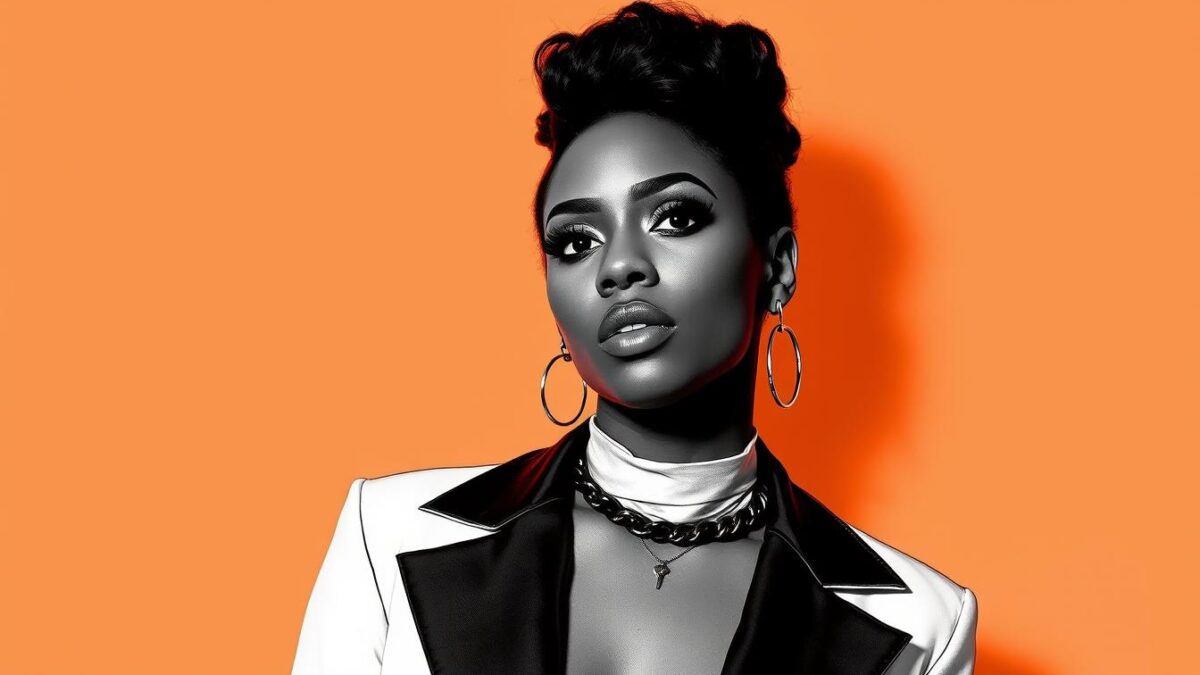
Her story starts in Kansas City, Kansas. Born on December 1, 1985, she transformed working-class roots into a groundbreaking career. This artist defies simple labels.
Her work blends science fiction with soul. It merges activism with artistry. She creates expansive worlds where music becomes a powerful form of protest.
At age 39, her achievements are vast. They include ten Grammy nominations and a Screen Actors Guild Award. She launched her own record label, Wondaland Arts Society, championing creative freedom.
Janelle Monáe’s journey reflects pure determination. From early demos to international tours, her vision never wavers. She commands attention across music, film, and cultural activism with unwavering authenticity.
Early Life and Inspiring Beginnings
From the humble beginnings of Quindaro, Kansas City, emerged a voice that would redefine contemporary music. The working-class neighborhood shaped her perspective from an early age.
Childhood Roots and Family Background
Born in 1985, Janelle Monáe Robinson grew up surrounded by extended family. Her mother worked as a hotel maid while her father drove trucks. The family faced challenges but maintained strong bonds.
Over fifty first cousins created a vibrant community in Kansas City. Church gatherings became central to family life. They attended multiple congregations where music filled the air.
| Family Influence | Church Affiliation | Musical Role |
|---|---|---|
| Mother’s Side | Baptist Church | Gospel Singers |
| Father’s Side | AME Church | Choir Members |
| Extended Family | Church of God in Christ | Performers |
Early Musical Influences and Dreams
The young singer found inspiration in unexpected places. Dorothy Gale’s journey resonated deeply with her own aspirations. Later, Lauryn Hill’s album became a treasured possession.
She purchased two copies with her first paycheck. Juneteenth talent shows became her proving ground. Winning three consecutive years revealed her natural talent.
These early experiences in Kansas City taught her that music could transform hardship. Family struggles became fuel for artistic expression. Church traditions provided the foundation for her powerful voice.
Formative Years and Breakthrough Moments
The path to a musical breakthrough was paved with bold choices and a fierce commitment to artistic independence. After high school, janelle monáe moved to New York to study musical theater.
She was the only Black woman in her class. This experience was both welcoming and concerning.
From College Campuses to a Musical Breakthrough
After eighteen months, she left the program. She feared losing her unique creative edge. A move to Atlanta and enrollment at Georgia Perimeter College followed.
There, she began writing her own original music. Her stories became her songs. This period was her creative laboratory.
Her official debut arrived in 2003. She self-released a demo album called “The Audition.” She sold copies from the trunk of her car on college campuses.
To make ends meet, she worked at Office Depot. A job termination sparked inspiration. She was fired for emailing a fan, an event that led to the song “Lettin’ Go.”
That track found its way to Big Boi of OutKast. He recognized her raw talent instantly. He became an early champion, opening doors to a wider audience.
These moments reveal an artist building her own path. It was a path built on hustle, talent, and an unwavering sense of self.
Navigating the Metropolis: Concept & Creativity
The year 2007 marked a creative explosion that would define an entire artistic universe. After signing with Bad Boy Records, Janelle Monáe unleashed a vision that blended science fiction with soul.
The Birth of Cindi Mayweather
She introduced Cindi Mayweather, an android from the year 2719. This character risked everything for forbidden love with a human. Cindi became a symbol for anyone society deems “other.”
The concept drew from Fritz Lang’s 1927 film “Metropolis.” It explored themes of class division and mechanized oppression. The android alter ego embodied struggles against conformity.
Metropolis: The Chase Suite and Early Demos
Originally conceived as a four-part series, “Metropolis: Suite I (The Chase)” arrived in 2007. Bad Boy released a special edition in 2008 with additional tracks. This EP earned critical acclaim and a Grammy nomination.
The chase suite established a cinematic approach to music. Each song functioned as a chapter in Cindi’s dystopian journey. The album blended funk, soul, and social commentary seamlessly.
Janelle Monáe’s signature black-and-white tuxedo look emerged here. It shifted focus from body objectification to artistic craft. The music created worlds where story illuminated real social struggle.
Album Milestones: The ArchAndroid and Electric Lady
With cinematic ambition and genre-defying sound, two studio albums redefined what pop music could achieve. These works established Janelle Monáe as a creative force.
Innovative Blend of Genres and Visual Storytelling
“The ArchAndroid” arrived in 2010 as a debut studio album that defied categorization. It blended classical orchestration with deep funk and R&B foundations. The album peaked at number 17 on the Billboard 200.
Cindi Mayweather’s story evolved from fugitive to messianic figure. This narrative continued Monáe’s science fiction mythology with stunning visual accompaniment.
“The Electric Lady” followed in 2013 with even greater musical diversity. This second album debuted at number five on the charts. It featured collaborations with Prince, Erykah Badu, and Solange.
The project explored jazz, pop-punk, gospel, and sensual ballads. Each track advanced the Metropolis narrative through sophisticated visual storytelling.
| Album Feature | The ArchAndroid (2010) | The Electric Lady (2013) |
|---|---|---|
| Billboard Peak | Number 17 | Number 5 |
| Musical Styles | Classical, Funk, R&B | Jazz, Pop-Punk, Gospel |
| Notable Collaborations | Big Boi, Of Montreal | Prince, Erykah Badu, Miguel |
| Narrative Focus | Android Messiah Story | Studio Aesthetic & Rebellion |
Boston City Council honored the artist with “Janelle Monáe Day” in October 2013. This recognition celebrated her social leadership through music.
Both albums demonstrated how ambitious concepts could maintain emotional impact. They cemented Monáe’s reputation for innovative pop music that never sacrificed groove for complexity.
Embracing Afrofuturism with Dirty Computer
Personal truth took center stage when the third studio album ‘Dirty Computer’ emerged in 2018. This work marked a significant departure from the Cindi Mayweather android persona.
The artist revealed that earlier career insecurities had fueled the protective character. Now she embraced direct self-expression without metaphorical shields.
Science Fiction Elements Meet Personal Identity
‘Dirty Computer’ presents a dystopian world where authorities erase unwanted memories. The concept explores identity cleansing in a surveillance state.
Critics celebrated the album as jubilant Afrofuturism. It centered Black queer joy while confronting authoritarian control.
Songs like “PYNK” and “Make Me Feel” celebrated sexuality with Prince-inspired funk. The production blended classic sounds with computer-age innovation.
A 48-minute narrative film accompanied the album release. It starred the artist alongside Tessa Thompson exploring memory resistance.
| Publication | Recognition | Year-End Ranking |
|---|---|---|
| Grammy Awards | Album of the Year Nomination | N/A |
| Billboard | Top 10 Album | Multiple Best-of Lists |
| Vox | Modern Science Fiction Praise | Album of the Year |
| Rolling Stone | Critical Acclaim | Top 10 Releases |
The ‘Dirty Computer’ world expanded beyond music with a 2022 cyberpunk story collection. This album represented both personal and artistic liberation for the creator.
Janelle Monáe: A Trailblazer in Music and Film
Awards from diverse institutions reveal the breadth of Janelle Monáe’s cultural influence. The trailblazer title is earned through consistent innovation across artistic mediums.
Her ten Grammy nominations span multiple categories, reflecting music that defies easy classification. She also received a Screen Actors Guild Award for ensemble work in “Hidden Figures.” This proves her acting matches her musical accomplishments.
Billboard Women in Music honored janelle monáe with the Trailblazer of the Year Award in 2018. Harvard University presented her with the Women’s Center Award for Achievement in Arts and Media. These honors acknowledge her impact beyond entertainment.
The artist’s 2022 Children’s and Family Emmy Award for “We the People” demonstrated remarkable range. It showed work that speaks to young audiences about civic responsibility. People recognize janelle monáe as someone who uses platform for purpose.
These honors from music industry bodies, film academies, and educational institutions reveal an artist whose work resonates across disciplines. The music created by janelle monáe entertains while challenging audiences to think more deeply.
Acting and Screen Presence: From Moonlight to Hidden Figures
A powerful screen presence emerged in 2016, with two landmark films arriving almost simultaneously. These roles immediately established the artist as a serious dramatic actor.
Her big-screen debut came in Barry Jenkins’s “Moonlight,” a film that would win the Academy Award for Best Picture. This was followed swiftly by a starring role in “Hidden Figures.” In that film, she portrayed NASA engineer Mary Jackson, honoring the first African American female engineer at the agency.
Award-Winning Performances and Cinematic Impact
Her performance in “Hidden Figures” earned a Critics’ Choice Movie Award nomination for Best Supporting Actress. The film was both a critical and commercial success, receiving multiple Oscar nominations.
Subsequent film roles continued this pattern of substance. She appeared in the Harriet Tubman biopic “Harriet,” the horror film “Antebellum,” and the mystery sequel “Glass Onion.” Each part centered Black women’s experiences and stories.
Television appearances, like in the psychological thriller “Homecoming,” demonstrated further range. Even voice work in “Rio 2” showed a commitment to family-friendly projects. Every role reflects a deliberate choice, avoiding stereotype for meaningful character depth.
Social Impact and Cultural Activism
A television studio became a pulpit for justice when the artist transformed a morning show into a platform for protest. Her work extends far beyond entertainment into meaningful social change.
Protest Anthems and Community Leadership
On August 14, 2015, Janelle Monáe and her Wondaland Arts Society collective performed “Hell You Talmbout” on NBC’s Today Show. This powerful protest song listed names of Black people killed by police brutality.
The lyrics became a chant demanding America remember victims like Eric Garner, Trayvon Martin, and Sandra Bland. Following the performance, she delivered an impassioned speech declaring Black America stands tall and will not be silenced.
Her activism continued with First Lady Michelle Obama’s “This Is for My Girls” collaboration in March 2016. The track supported the Let Girls Learn initiative for educational access worldwide.
This artist understands visibility itself becomes activism. Her work centers intersectionality, addressing race, gender, and class through both explicit protest songs and broader artistic representation. People respond because her activism feels genuine rather than performative.
The Power of Collaborations and Partnerships
Strategic partnerships amplified her voice across musical genres. These connections transformed local talent into global artistry.
Big Boi discovered the young artist at an Atlanta open mic. He immediately recognized her unique talent. This led to features on OutKast’s “Idlewild” album.
Big Boi’s advocacy proved crucial. His recommendation to Sean Combs secured the Bad Boy Records deal. This gave the artist her national platform.
Working with Industry Giants and Emerging Artists
The collaboration with fun. on “We Are Young” became career-defining. The song topped Billboard charts and earned diamond certification.
Prince selected her for “The Electric Lady.” This validation came from music’s most selective perfectionist. Erykah Badu joined on “Q.U.E.E.N.,” creating powerful dialogue.
She worked across genres with diverse artists. From Grimes to Duran Duran to Sérgio Mendes. Each partnership expanded her musical vocabulary.
| Collaborator | Project | Impact | Genre |
|---|---|---|---|
| Big Boi | OutKast’s Idlewild | National exposure | Hip-hop |
| fun. | We Are Young | Billboard #1 hit | Pop rock |
| Prince | The Electric Lady | Creative validation | Funk/R&B |
| Erykah Badu | Q.U.E.E.N. | Artistic dialogue | Neo-soul |
| Duran Duran | Pressure Off | Cross-genre reach | New wave |
These collaborators recognized her as peer and innovator. Each partnership strengthened rather than diluted her artistic vision. The artist maintained core identity while expanding creatively.
Innovative Concepts and Artistic Evolution
The fourth studio album arrived as a vibrant departure, trading science fiction allegory for sun-drenched celebration. “The Age of Pleasure” emerged in 2023, earning a Grammy nomination for Album of the Year.
This collection of songs was born from a desire to party and dance with loved ones after pandemic isolation. It marks a clear shift from dystopian themes to a focus on joy and liberation.
Critics immediately noted the change in tone. The Washington Post called the music “pool-party” ready. Pitchfork described its “ecclesiastic enjoyment of indulgence.”
The album’s sound incorporates amapiano, reggae, and global pop influences. It maintains an Afrofuturist spirit while centering Black queer joy and sensuality with directness.
This release proves the artist’s ability to create compelling albums without elaborate frameworks. “The Age of Pleasure” completes an evolution toward full, unfiltered self-expression.
Wondaland Arts Society: Cultivating New Talent
In 2015, a landmark partnership transformed Monáe’s creative collective into a fully-fledged record label with industry reach. The joint venture with Epic Records gave Wondaland Arts Society distribution power while maintaining artistic independence.
Billboard dubbed janelle monáe a “mini-mogul” for negotiating terms that benefited her artists. The deal showed her understanding of industry infrastructure.
Empowering Emerging Artists and New Sounds
The label’s roster included distinctive artists like Jidenna, whose “Classic Man” became a hit. Roman GianArthur, St. Beauty, and Deep Cotton also joined the collective.
Their debut compilation “The Eephus” proved the label’s commercial viability. The five-song EP reached number 22 on the Billboard 200 chart.
Wondaland prioritizes artists who push boundaries and center marginalized perspectives. The label functions as an artistic family with frequent collaborations.
In 2018, the operation expanded into film through a Universal Pictures deal. This move championed underrepresented voices across multiple media platforms.
The record label demonstrates how independent-minded artists can build sustainable business models. It serves art and community rather than just extracting profit from talent.
Final Reflections on a Music Icon
Janelle Monáe’s artistic legacy is a testament to the power of vision. She blends pop innovation with an unwavering social conscience. Her music challenges listeners while making them dance.
As a singer, her iconic black-and-white look commands respect. It centers craft over everything else. This artist draws from greats like Lauryn Hill and Michael Jackson but creates a sound entirely her own.
The “Dirty Computer” era was a pivotal moment of personal revelation. It followed the critically acclaimed “Electric Lady” album. This body of work merges the political and personal within pop and funk.
Janelle Monáe’s journey from Kansas City to international fame reflects pure determination. Her art is a blueprint for a more liberated world. She proves that an artist can entertain, provoke, and inspire all at once.