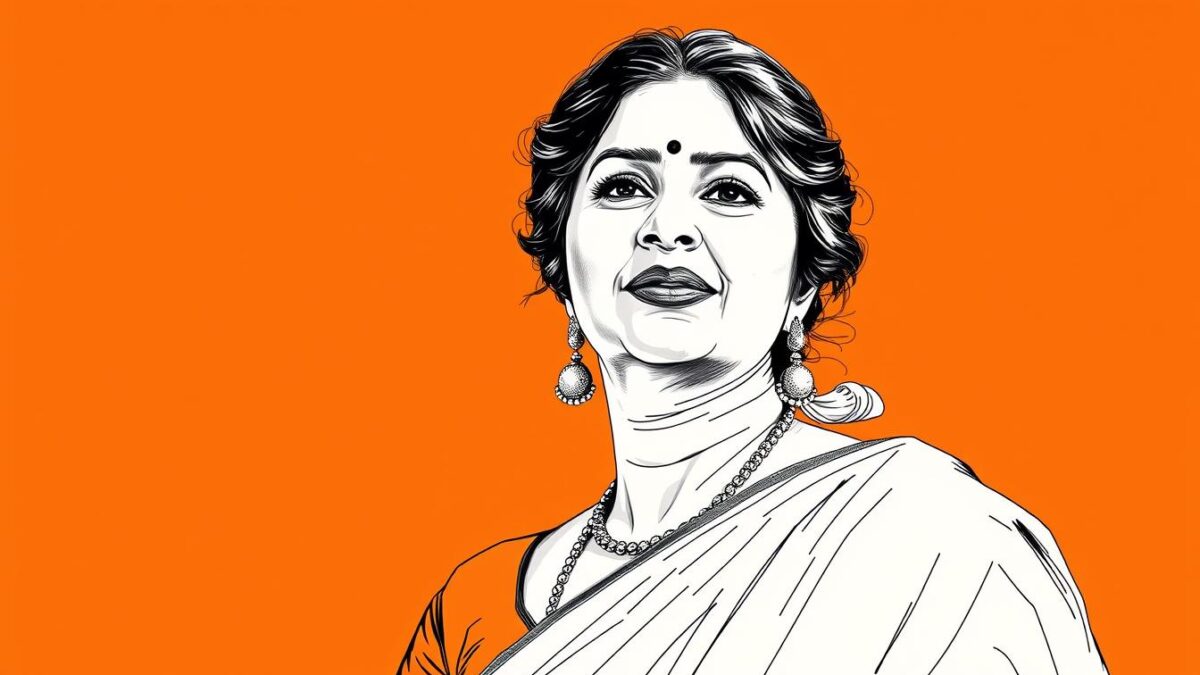
Her voice defined an era of Indian film and devotional music. Anuradha Paudwal is a legendary singer with a career spanning over five decades.
She began as Alka Nadkarni in Karwar, Karnataka. Her journey would take her from radio to becoming one of Bollywood’s most successful playback artists.
The singer’s work includes thousands of songs across languages. She earned titles like “Bhajan Queen” for her profound impact on devotional music.
Anuradha Paudwal’s story is one of incredible talent and resilience. It is a legacy built on melody that continues to resonate with millions today.
Early Beginnings and Breakthrough Moments
Her career began in the quiet hum of radio studios, a world away from the glamour of Bollywood. This period honed her technical skill and built the confidence needed for a major break.
Discovering Her Roots in Radio and Film
The singer’s official entry into playback singing came in 1973. S.D. Burman selected her for a Sanskrit verse in the film ‘Abhiman’. This was a significant debut at a time when established voices dominated the industry.
Throughout the 1970s, she worked mostly as a dubbing artist. She recorded guide versions of songs that were often later re-sung by bigger names. This work provided crucial experience but offered little fame.
Her marriage to music composer Arun Paudwal connected her to the industry’s inner circle. He worked as an arranger for S.D. Burman. This relationship provided professional insight during her early career.
The Impact of “Tu Mera Janu Hai” on Her Rising Fame
A major turning point arrived with the 1983 film ‘Hero’. She was initially asked to dub the song “Tu Mera Janu Hai” for Lata Mangeshkar.
Music directors Laxmikant-Pyarelal heard her version and made a pivotal decision. They felt the debutante actress deserved a fresh singing voice. They kept Anuradha Paudwal’s recording for the final soundtrack.
This accidental break launched her commercial career. The song’s success proved her voice could carry a hit film. It opened doors that had remained closed for a decade.
This led to a popular mid-80s partnership with singer Mohammed Aziz. Their duo defined numerous soundtracks and cemented her place in film music.
Versatile Musical Genres and Award-Winning Achievements
Few artists have demonstrated such seamless movement between the glamour of Bollywood and the spiritual depth of devotional music. This versatility defined her career across multiple languages and formats.
Exploring Filmi, Bhajan, and Devotional Music
Her catalog spans over 9,000 recordings across fifteen languages. She moved effortlessly from romantic film songs to Sanskrit verses.
The transition to devotional music began with a request from Gulshan Kumar. He asked her to record Durga bhajans just before Navratri.
These devotional recordings sold immediately upon release. They revealed an untapped market for high-quality spiritual music.
Her devotional work achieved extraordinary digital success. The Hanuman Amritwani crossed 450 million YouTube views.
Accolades: National Film Award, Filmfare Awards, and More
She earned four Filmfare Awards during her career. Her most remarkable achievement was three consecutive wins from 1990-1992.
The National Film Award came in 1989 for a Marathi song. This proved her mastery extended beyond Hindi cinema.
Government honors accumulated over decades. She received the Padma Shri in 2017 among many state awards.
This dual success in both commercial and spiritual music established a rare legacy. Each genre reinforced the other’s impact.
Anuradha Paudwal: Icon of Musical Excellence
Collaboration defined the second phase of her musical journey. She worked across generations, adapting her style to complement diverse voices.
Navigating Bollywood and Collaborative Ventures
Her partnerships spanned legendary singers from Kishore Kumar to modern stars. This flexibility showed her professional versatility across eras.
She recorded 23 songs with music composers Nadeem-Shravan. These tracks appeared in three blockbuster films from the early 1990s.
| Collaboration Type | Key Partners | Notable Works | Impact |
|---|---|---|---|
| Male Singers | Kishore Kumar, Kumar Sanu, Udit Narayan | Film duets across decades | Showed vocal adaptability |
| Female Singers | Alka Yagnik, Kavita Krishnamurti, Asha Bhosle | Group recordings | Demonstrated professional harmony |
| Music Composers | Nadeem-Shravan | Aashiqui, Sadak soundtracks | Defined 1990s Bollywood music |
Television appearances kept her connected to new audiences. Shows like Indian Idol and The Kapil Sharma Show shared her career insights.
Entry into Politics and Social Contributions
In March 2024, she joined the Bharatiya Janata Party. This move expanded her career into political influence.
Her Suryodaya Foundation focuses on social work. International recognition includes UN Cultural Ambassador status.
This multifaceted career shows how artistic success leads to broader impact. Her journey continues to inspire beyond music.
Challenges, Rivalries, and Resurgence in Bollywood
Professional rivalries shaped a significant chapter in her musical journey. The singer openly challenged Lata Mangeshkar’s recording records and criticized industry monopolies. This bold stance created admiration but also professional consequences.
Many music directors feared working with her due to potential backlash. Instances occurred where her recorded songs were replaced with Lata Mangeshkar’s voice. This tension limited opportunities throughout her career.
Industry Rivalries and Overcoming Obstacles
At her peak, she made a strategic decision to sing exclusively for T-Series. This move proved disastrous for her Bollywood career. Other female playback singers quickly captured the opportunities she left behind.
Her songs dominated the 1990 Binaca Geetmala chart with 14 entries. Yet the exclusivity arrangement prevented wider collaboration. The music industry began shifting away from her signature style.
Making a Triumphant Re-Entry in Bollywood
The 1997 murder of Gulshan Kumar freed her from the T-Series contract. She returned to Bollywood through labels like Tips Industries and Venus Records. Though she received quality songs, the industry landscape had changed.
Alka Yagnik now dominated the playback singing scene. Her comeback attempts couldn’t match earlier success levels. The iconic “Dil Hai Ke Manta Nahin” represented both her peak and subsequent challenges.
She continued recording until 2006 before leaving Bollywood. Her final film song was “Palkein Uthake Dekhiye” from Jaane Hoga Kya. This gradual exit marked the end of an era in her music career.
Legacy and Enduring Impact on the Music Industry
Personal resilience and professional adaptability defined her journey beyond the Bollywood spotlight. The singer’s devotional music continues to reach global audiences through digital platforms.
Her YouTube ranking among top global artists shows spiritual songs command lasting appeal. These devotional recordings accumulate millions of views across generations.
In a 2014 interview, she shared her philosophy about life beyond film music. She credited spiritual devotion and marketing savvy for her dual success.
Her career demonstrates that musical influence extends far beyond commercial hits. Anuradha Paudwal’s legacy continues through streaming platforms and cultural memory.