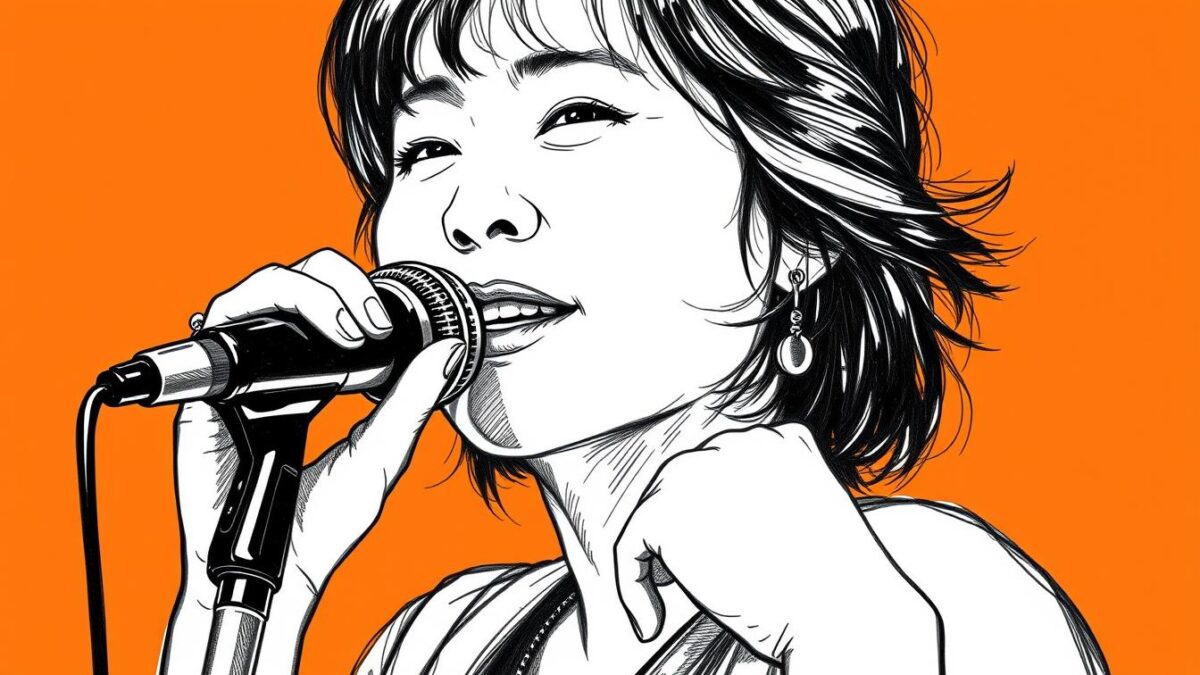
Akiko Yano stands as one of Japan’s most inventive musical forces. Born in Tokyo and raised in Aomori, she began her professional career in the mid-1970s. Her work spans nearly five decades.
This artist blends jazz, pop, and electronic music into a singular sound. Her distinctive vocal approach defies easy categorization. She started as a session musician in her teens.
The musician evolved into a prolific singer and composer. She collaborated extensively with Yellow Magic Orchestra. Her work helped shape techno-pop in Japan.
Her career includes over 30 studio albums and international tours. She has recorded with artists like Pat Metheny. She relocated to New York City in 1990 and continues to perform.
Early Life and Musical Beginnings
Akiko Suzuki’s musical journey began not on stage, but at a piano in Aomori. Far from Tokyo’s industry, her formative years were quiet.
This environment shaped her unique artistic perspective from the start.
A Childhood Immersed in Music
Her mother loved classical music and planted the seed early. She was born Akiko Suzuki and started piano lessons at age three.
The instrument quickly became her primary voice. She developed a deep, lifelong connection to the piano.
This early training gave her a strong technical foundation. It was a gift that would last a lifetime.
Transition to a Professional Musician
Akiko Suzuki made a bold choice at fifteen. She left high school and returned to Tokyo to pursue music.
Her youth did not hold her back. By seventeen, she worked as a session musician.
She carved out space in the competitive jazz scene. This period was a crucial time for her growth.
Playing with bands like Tin Pan Alley honed her skills. It fused her classical background with new, vibrant sounds.
This rapid evolution prepared Akiko Yano for her solo career. Her path was set.
Breakthrough and Career Highlights
A cross-cultural musical explosion occurred in July 1976 that would redefine Japan’s pop landscape for decades to come.
Debut Album: Japanese Girl
Her debut album arrived like a bolt from the blue. “Japanese Girl” blended American jazz-rock with Japanese sensibilities in a way no one had heard before.
The record was cut in Los Angeles with Little Feat, icons of the West Coast rock scene. It featured nine original compositions that married blues, jazz, pop, and traditional Japanese folk music.
This bold collaboration paid off spectacularly. The album became an instant hit in Japan, establishing the artist as a major talent overnight.
Rise with Yellow Magic Orchestra
Collaboration with Yellow Magic Orchestra began organically through shared Tokyo circles. She joined the band on two world tours in 1979 and 1980.
Her contributions brought rock-and-roll energy to their precise electronic sound. She performed her song “Zaikungtong Shonen” as a setlist staple.
Pioneering Electronic Pop
The 1980 album “Gohan Ga Dekitayo” marked her full embrace of electro-pop. Backed by Yellow Magic Orchestra, it became one of the earliest CDs released in 1982.
Her 1981 record “Tadaima” remains a fan favorite. It split between commercial pop and experimental children’s poetry settings.
The album featured Yellow Magic Orchestra members and a playful, cartoonish cover. It cemented her reputation as an artist who refused genre boundaries.
Exploring Diverse Musical Genres
Genre boundaries meant little to this innovative artist. She treated musical styles as colors on a palette rather than rigid categories.
Fusion of Jazz, Pop, and Traditional Japanese Folk
Her 1976 debut “Japanese Girl” showcased this unique approach. It blended American jazz with Japanese folk music elements. Record Collector magazine noted the sound still feels fresh decades later.
Yano described her creative philosophy clearly. “I never like sticking to just one vision,” she explained. “I always see my sound as being a spectrum.”
After exploring techno-pop, she deliberately returned to jazz fusion. The album “Touge no wagaya” marked this pivot. She refused to be confined to one musical style.
Her 1989 record “Welcome Back” featured jazz legends Pat Metheny and Charlie Haden. This album signaled her intentional return to the genre. It demonstrated her commitment to artistic evolution.
She also created “Super Folk Song” with just piano and vocals. These elements formed what she called “the base of my music.” Each album captured a different facet of her curiosity.
This restless exploration made her work harder to market. Yet it ensured her artistic vitality remained strong throughout her career.
The Legacy of Akiko Yano in Modern Music
During Japan’s economic ascent, a unique sound emerged that would define an era. Akiko Yano served as its accidental architect. Her work blended tradition with modernity at a pivotal time.
Her artistic signature was a refusal to repeat herself. Each album explored new terrain. This versatility made her music rich and enduring.
Signature Style and Artistic Innovation
Her sound was a postmodern mix. It was experimental yet accessible. It captured the contradictions of Japan’s rapid modernization.
She played a leading role in establishing techno-pop. This was often credited solely to her famous collaborators. Her 1981 album “Tadaima” foregrounded electronic elements with confidence.
| Element | Characteristic | Example |
|---|---|---|
| Genre Fusion | Blended pop, jazz, folk, and classical | “Japanese Girl” (1976) |
| Vocal Approach | Playful, serious, and defying categorization | Performance style |
| Production | Innovative use of electronics and piano | “Tadaima” (1981) |
This artist composed and produced her own records. She carved out space in a male-dominated industry through sheer talent.
Influence on the City Pop Movement
The singer emerged as an accidental visionary of city pop. This glossy sound reflected Japan’s bubble economy. Her music became a sonic blueprint for the genre.
Her contributions to music history remain somewhat overshadowed. Yet her influence is deeply woven into the fabric of that time. She pioneered a “new age of culture” with a sound that was both humorous and serious about progress.
International Collaborations and Global Impact
Collaboration became the cornerstone of her artistic evolution, spanning continents and cultures. Her work consistently crossed borders, creating genuine cross-cultural dialogue.
Partnerships with Renowned Musicians
The artist’s collaborative spirit extended far beyond Japan. She worked extensively with Yellow Magic Orchestra members Ryuichi Sakamoto, Haruomi Hosono, and Yukihiro Takahashi.
Her partnerships read like a who’s who of international music. She recorded with jazz legends Pat Metheny and Charlie Haden. She also collaborated with British band Japan at London’s AIR Studios.
In 1982, she created the album “Ai Ga Nakucha Ne” with that band. The record company released it as a special photo-book set.
Touring the World and Creating Cross-Cultural Music
Her global presence grew through extensive touring across Europe and the United States. She performed at prestigious venues like Montreux Jazz Festival.
After relocating to New York City in 1990, she established a base for international work. She became a regular performer at Joe’s Pub.
Her 2007 partnership with electronic musician Rei Harakami formed the duo Yanokami. This demonstrated her ongoing commitment to exploring new sounds.
Western critics often compared her vocal style to Kate Bush. Yet she developed her approach independently years earlier.
Reflections on a Musical Journey
From the challenges of single motherhood to late-career rediscovery, her path reflects resilience and artistic integrity. Akiko Yano balanced recording sessions with raising children, taking a year off after her 1984 album to focus on family.
She described feeling “like a squirrel in a cage” during those demanding years. Yet her commitment to both roles never wavered.
Each record in her extensive catalog captures a distinct moment. From “Japanese Girl” to recent works like “Asteroid and Butterfly,” every album showcases her evolving style.
Recent interviews reveal her surprise at finding new audiences. “I played in New York last year and was blown away by the crowd,” she shared. Young listeners now discover her pioneering work.
Her philosophy remains unchanged: “I didn’t picture myself as a pop artist. So I did what I wanted.” This independence defines her entire career.