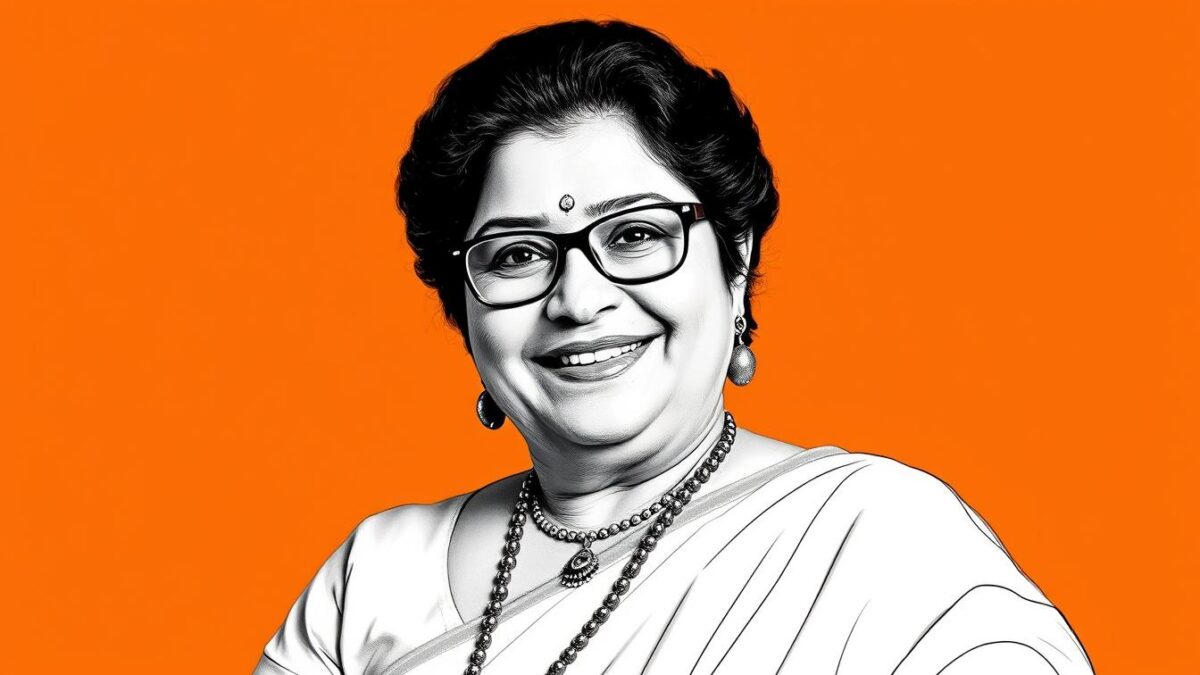
A deep, textured voice cuts through the noise. It defies every convention. This sound belongs to a true star of Indian music.
Born in Mumbai on November 7, 1947, this artist grew up in a home filled with diverse sounds. Her father, Vaidyanath Someshwar Sami Iyer, nurtured a love for music from many traditions.
Her career spans decades, moving from nightclubs to Bollywood and international stages. She built a life dedicated entirely to her craft. This journey redefined what Indian pop could be.
The Indian government recognized her immense impact. She received the Padma Shri in 2011. Her legacy was cemented with the prestigious Padma Bhushan award in 2024.
This is the story of Usha Uthup. It explores a singer whose unique voice continues to resonate across the world and through the years.
Early Life and Musical Influences
The foundation for an iconic career was laid in an unconventional classroom. At St. Agnes High School, a young singer’s deep voice did not fit the mold. Instead of rejection, a perceptive teacher handed her clappers and triangles. This early moment taught a vital lesson about finding one’s own path in music.
Family Background and Early Education
Her family life was a rich sonic environment. Her father, Vaidyanath Someshwar Sami Iyer, ensured the home was filled with diverse sounds. Western classical, Hindustani, and Carnatic music played daily from the radio.
Legends like Kishori Amonkar and Bade Ghulam Ali Khan became the soundtrack to her day. This exposure, without formal training, shaped her innate musical understanding.
Discovering Music in a Rich Cultural Setting
A pivotal influence lived next door. Jamila, the daughter of a police commissioner, encouraged her to learn Hindi and study Indian classical music. This fusion became key to her future sound.
Her first public singing happened at age nine. Her sisters introduced her to famed radio announcer Ameen Sayani. He gave her a spot on Radio Ceylon’s Ovaltine Music Hour.
She sang “Mockingbird Hill,” a song that started a journey. Radio appearances throughout her teenage years honed a voice that defied genre. This unique blend of influences prepared Usha Uthup to pioneer Indian pop.
Breakthrough in Music and Legendary Nightclub Performances
The singer’s professional journey began not on a grand stage, but in a basement. In 1969, she walked into Nine Gems, a small Chennai nightclub. Her image—a traditional saree and leg calipers—defied every expectation for a nightclub performer.
That first show was an instant success. The audience response was so powerful the owner extended her stay for a full week. This launched a career built on raw connection and authenticity.
From Chennai, she moved to Calcutta’s legendary Trincas club. It was there she met her future husband, Jani Chacko Uthup. She also commanded the stage at Mumbai’s Talk of the Town.
Her presence was warm and powerful. People felt an immediate loyalty to this unconventional artist.
From Mumbai’s Nightclubs to International Stages
A chance encounter at a performance changed everything. A film crew from Dev Anand’s Navketan unit saw her sing. They offered a chance at Bollywood playback singing.
Her film debut came with Bombay Talkies in 1970. She sang an English number composed by Shankar-Jaikishan. This was followed by a part in the 1971 hit Hare Rama Hare Krishna.
Her voice also traveled globally. She recorded popular English covers that sold well in India. Time in London led to BBC radio interviews, broadening her reach.
Bollywood Debut and Global Recognition
International fame grew during a trip to Nairobi. She became a sensation singing nationalistic songs in Swahili. President Jomo Kenyatta made her an Honorary Citizen of Kenya.
She even performed “Malaika” with its original singer, Fadhili Williams. This period cemented her status as a true crossover artist.
Throughout the 1970s and 80s, she created memorable songs with legends like R.D. Burman and Bappi Lahiri. Her unique sound became a vital part of India’s musical fabric.
Usha Uthup: A Trailblazer in Indian Pop and World Music
She turned perceived limitations into her greatest strengths on the world stage. Her deep, resonant voice and traditional Kanjivaram saree became an unforgettable signature. This combination defied the glamorous expectations of nightclub culture in the late 1960s.
It was not a planned image. It was simply who she was. Her authenticity created a powerful connection with the audience that lasted for years.
Iconic Voice, Signature Saree, and Unconventional Style
Her contralto voice was a force of nature. It gave her music a unique depth and warmth. This sound set her apart in an industry that often favored higher pitches.
The singer never felt pressure to change her style or her music. She believed every performance should be driven by genuine emotion. This realness is what people grew to love.
Her story is one of pure self-belief. She proved that being yourself is the most powerful brand of all.
Cross-Genre Versatility and Enduring Impact
Her love for music knew no boundaries. She moved effortlessly from pop anthems to jazz standards and children’s rhymes. Usha Uthup made famous songs like “Mehbooba Mehbooba” entirely her own.
She even recorded Hindi versions of international hits by Michael Jackson and Gloria Gaynor. Collaborations with rock bands like Parikrama showed her adaptability.
This incredible versatility earned her numerous awards over time. Her impact on music is a testament to the power of an authentic voice and a fearless spirit.
Acting Ventures and Stage Presence
Her commanding stage presence translated seamlessly to film and television roles across multiple languages. The singer brought the same authentic energy to acting that defined her musical career.
She made her film debut in character roles that showcased her versatility. In 2006, she played Kurisuveettil Mariamma in the Malayalam film Pothan Vava.
Filmography, Television Roles, and Cameo Appearances
Usha Uthup took on memorable parts in notable productions. She appeared in Vishal Bhardwaj’s 7 Khoon Maaf as Maggie Aunty, also singing for the film.
Her television presence became equally influential. She served as a judge on multiple singing reality shows across different languages.
The artist judged Idea Star Singer in Malayalam and appeared on Indian Idol in disguise. These roles showcased her playful side and deep musical knowledge.
She brought warmth to every show, whether judging or performing. Her stage craft remained consistent across all mediums.
Recent news highlights her continued relevance. In 2019, she appeared on the Kapil Sharma Show and recorded for a Bob Dylan documentary.
Reflecting on a Storied Legacy and Future Prospects
Beyond the awards and the iconic voice lies a deeply personal narrative of partnership and resilience. For the singer, music was not just a career but a vital force. She famously stated it was something she needed to live, with performing being as natural as breathing.
This life was anchored by a profound love story with her husband, Jani Chacko Uthup. Their bond began in a Kolkata nightclub and endured for decades. His recent passing due to cardiac arrest was a profound loss for the family and her fans.
Her daughter, Anjali, remembered him as a true gentleman. The singer’s legacy, honored with the Padma Bhushan, is one of authentic voice and heartfelt courage. It is a story that continues to inspire, echoing long after the final note.