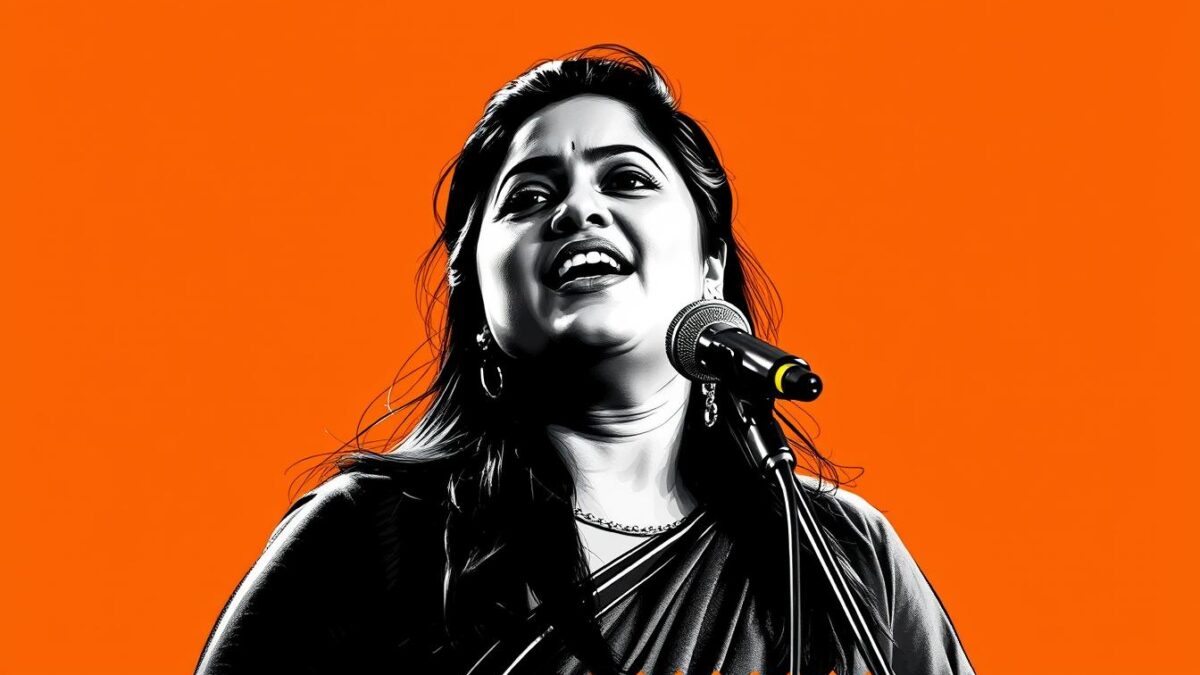
Her voice cuts through the noise. It is a powerful instrument, grounded in tradition yet fiercely modern. This is the sound of Sona Mohapatra, an artist who defies easy labels.
Born in 1976, she brings a commanding presence to the stage. Standing 5’7″, her distinctive style matches her artistic boldness. She built a career that spans singing, composing, and producing.
Her work bridges worlds. She finds the soul in a classic David Bowie track and gives an INXS song new life. This skill makes her a unique force in Indian music.
Her life in Mumbai is a creative partnership with her husband, composer Ram Sampath. Together, they run their production house, OmGrown Music. It is a hub for their artistic vision.
The journey from mechanical engineering graduate to celebrated vocalist is a story of transformation. It is a path marked by artistic risk and a refusal to follow the usual script.
Early Life, Education, and Musical Beginnings
The foundation of Sona Mohapatra’s distinctive sound was built not in a music conservatory, but in lecture halls for engineering and business. Her academic path was unconventional for an artist. She earned a BTech in Mechanical Engineering in Bhubaneswar before pursuing an MBA in Pune.
Engineering and MBA Background
This technical and marketing education gave her a unique edge. She understood the commercial side of the music industry from the inside out. This business acumen would later distinguish her from peers with purely artistic training.
She worked as a brand manager for Marico. It was a stable corporate career. Leaving it for the uncertainty of a singing career was a calculated risk. It required deep self-awareness and courage.
Breakthrough with Advertising Jingles
Her first major break came through advertising. The voice for the iconic Tata Salt “Kal Ka Bharat Hai” jingle introduced her to millions of Indian homes. It was a powerful entry into the public’s consciousness.
Her versatility shone in the multinational Close Up “Paas Aao Na” campaign. The song was recorded in several languages. It aired across 13 countries for four consecutive years. This established her as a vocalist with wide appeal.
A pivotal moment occurred in 2002. While still at Marico, director Ram Madhvani introduced her to composer Ram Sampath. This meeting would later blossom into a profound creative and personal partnership. These early years were a crucial training ground. Business savvy met artistic ambition, preparing Sona Mohapatra for a unique path.
Sona Mohapatra’s Rise to Prominence and Musical Journey
Breaking free from advertising jingles, Sona Mohapatra established her artistic identity with a genre-defying debut album. Her 2007 release “Sona” on Sony Records blended rock, blues, Flamenco, and traditional Indian styles. This ambitious project showcased her refusal to be confined by genre expectations.
Transition from Indie Albums to Bollywood Hits
The breakthrough came with “Bedardi Raja” from Delhi Belly in 2011. Her edgy, contemporary sound introduced a fresh voice to mainstream Bollywood. The track included her on-screen cameo, marking her arrival as a complete performer.
Collaborations with Ram Sampath and Creative Partnerships
Her marriage to composer Ram Sampath in 2005 blossomed into a profound creative partnership. Together they created memorable soundtracks for Delhi Belly and Talaash. Their collaboration extended beyond traditional composer-singer dynamics.
Impact of Satyamev Jayate and Signature Performances
Satyamev Jayate with Aamir Khan became her transformative platform. She served as lead vocalist and executive producer, managing complex multilingual recordings. The anthem “Mujhe Kya Bechega Rupaiya” garnered over 26 million views.
Her signature Bollywood performances like “Jiya Laage Na” and “Ambarsariya” earned critical acclaim. These tracks highlighted her ability to blend contemporary sounds with traditional Oriya influences. Her work brought rare regional flavors to mainstream cinema.
Creative Collaborations, Notable Works, and Industry Highlights
Beyond the studio and stage, her notable works extend into award-winning documentary filmmaking. This artist’s career is a mosaic of bold experiments and recognized achievements.
Albums, Singles, and Cross-Cultural Remixes
Her musical curiosity shines in cross-cultural projects. She reinterpreted David Bowie’s “Let’s Dance” and INXS’s “Afterglow,” filtering rock classics through an Indian lens. The latter became a standout success.
Platforms like Coke Studio showcased her versatility. Her 2015 performance of “Rangabati” sparked conversation by reimagining traditional Oriya folk music for a national audience.
Her Bollywood journey features powerful duets. She shared vocals with stars like Shreya Ghoshal, Armaan Malik, and Arijit Singh. These collaborations highlighted her vocal compatibility.
| Song | Film | Year | Collaborators |
|---|---|---|---|
| Bahara | I Hate Luv Storys | 2010 | Shreya Ghoshal |
| Naina | Khoobsurat | 2014 | Armaan Malik |
| Chori Chori | Hunterrr | 2015 | Arijit Singh |
| Beda Paar | Laapataa Ladies | 2024 | Ram Sampath (Composer) |
Documentary Projects and Innovative Music Videos
The documentary “Shut Up Sona” offered a raw, honest look at her life. It won multiple film festival awards, revealing both personal and professional challenges.
Her understanding of modern music extends to visual storytelling. Releases like “Dekh Le” (2013) demonstrate her evolution as a complete visual artist.
Industry acclaim followed her diverse work. She earned nominations at Screen Awards, Mirchi Music Awards, and others. This recognized both her film hits and independent pop songs.
Reflecting on a Legacy and Future Pathways in Music
Her artistic journey represents a rare balance of commercial success and unwavering integrity. Sona Mohapatra built a career that refuses the conventional playback singer model. She maintains creative control through her production house, OmGrown Music.
The singer’s advocacy work demonstrates equal courage. During India’s #MeToo movement, she accused prominent composers of misconduct. This risked professional relationships but upheld principles. She later faced death threats for criticizing a major star’s behavior.
Her creative partnership with Ram Sampath spans two decades of marriage and business. Together, they champion underrepresented regional sounds. She brings Oriya musical traditions to mainstream consciousness against dominant influences.
Recent work like 2024’s “Beda Paar” proves her continued relevance. The artist’s legacy is one of versatility and courage. She uses her platform for both artistic expression and social commentary.